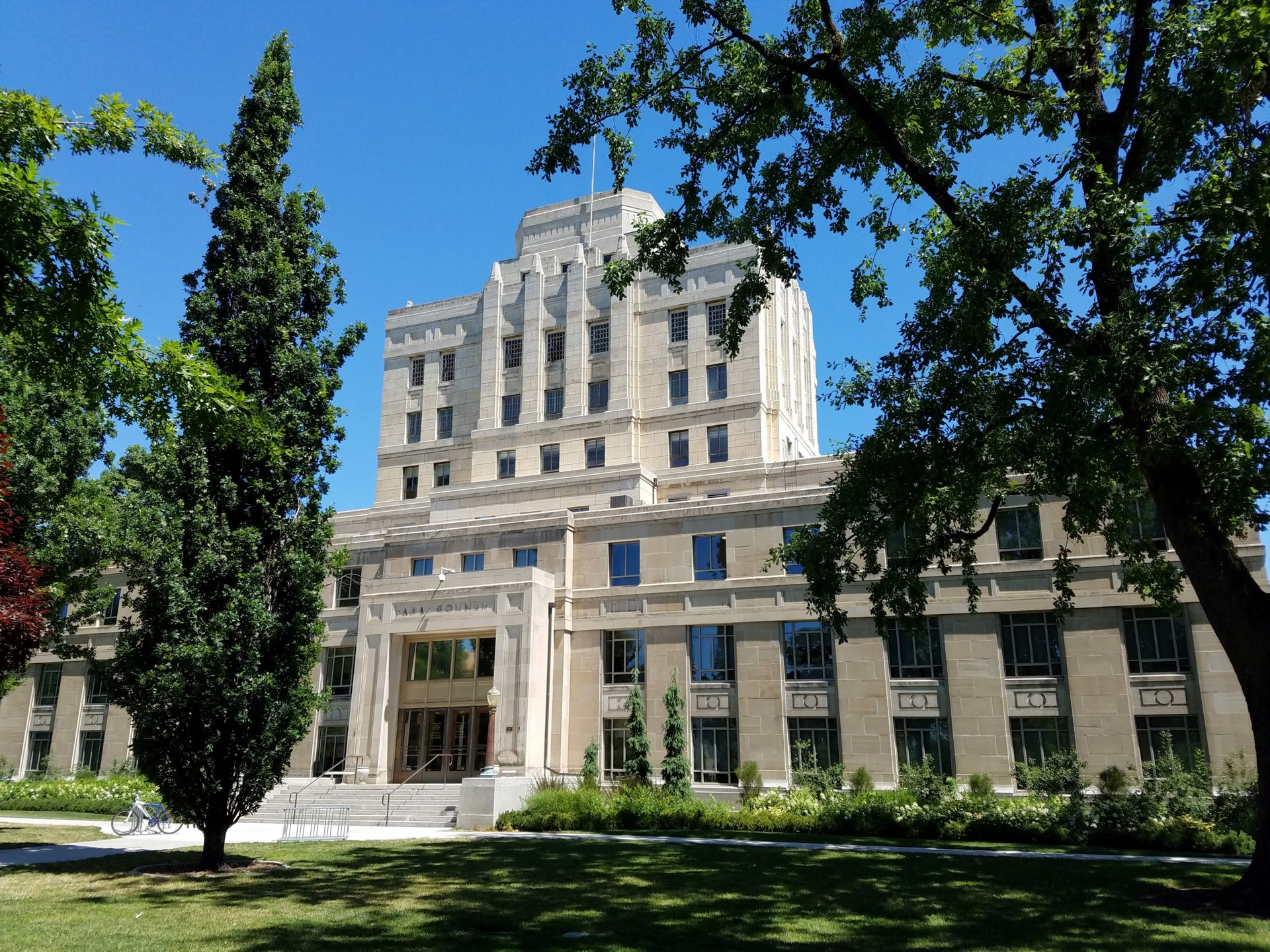
The Ada County Courthouse is the government building in downtown Boise that houses Idaho’s Fourth Judicial District Court for Ada County, along with several county offices. It is a working courthouse, not a museum, but its public lobby and atrium contain a collection of commissioned artwork, including murals, installed as part of the building’s construction.
What is the Ada County Courthouse, exactly?
It is the seat of judicial and administrative business for Ada County, Idaho’s most populous county and the one that contains Boise. The building holds courtrooms for the Fourth Judicial District — which covers Ada, Boise, Elmore, and Valley counties — along with the offices of the Ada County Clerk, the county recorder, and related county government functions. It is where residents deal with jury duty, civil filings, criminal proceedings, and property and marriage records for the county.
This is a distinct role from the Idaho State Capitol a few blocks away, which houses state government and the legislature. The courthouse is county-level infrastructure; the Capitol is state-level. Readers curious about the Capitol’s own building and history can see the guide to visiting the Idaho State Capitol and the separate piece on its geothermal heating system for comparison.
Where is it, and what did it replace?
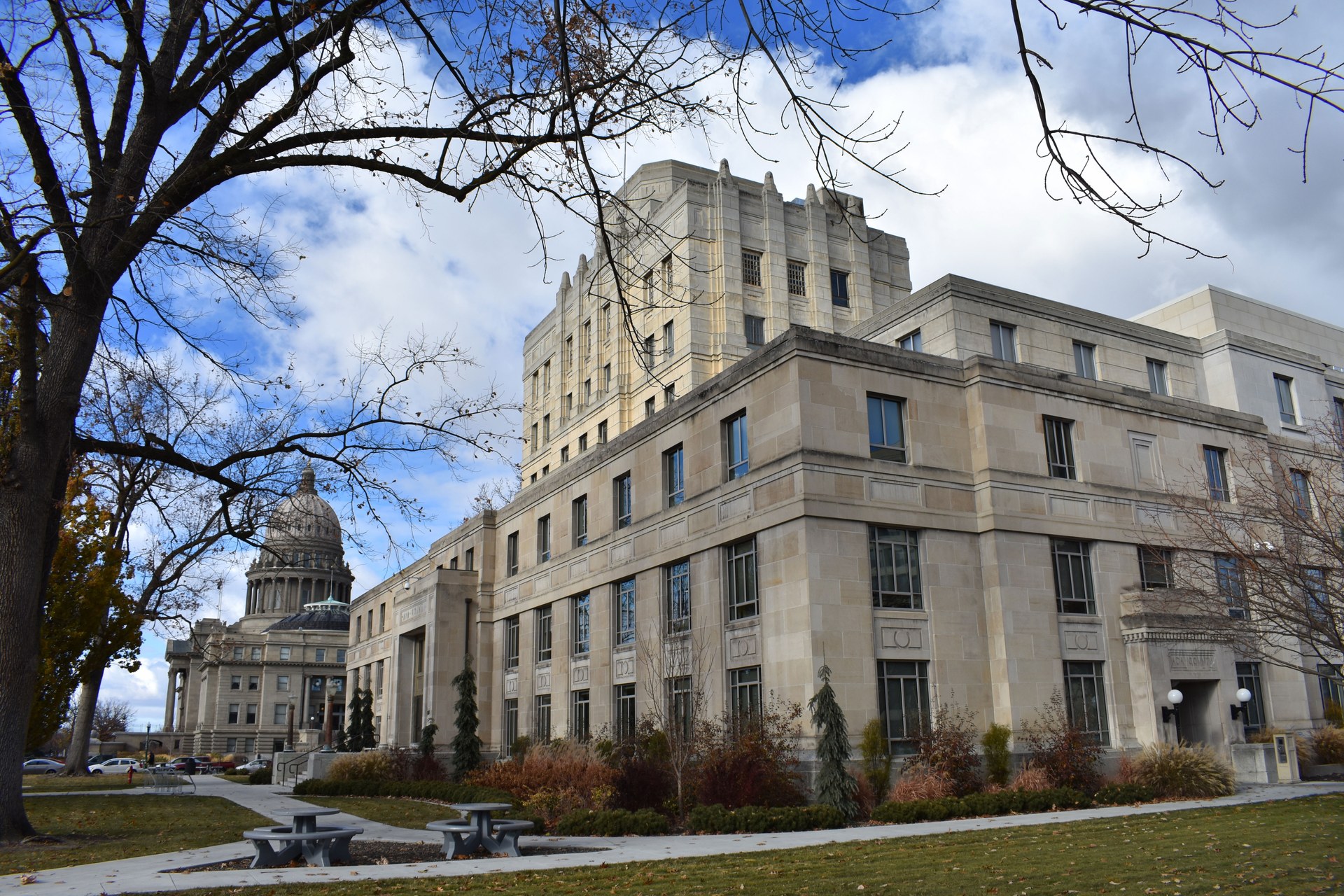
The courthouse sits in downtown Boise, close to the Boise River and the civic core of the city, within walking distance of the Capitol and the main downtown grid described in the piece on what Capitol Boulevard connects. The current building dates to the early 2000s and replaced an earlier Ada County Courthouse, an Art Deco structure completed in the late 1930s that served the county for roughly six decades before it was retired and the present building took over its functions.
Ada County’s own government pages, and the county’s records office, are the authoritative sources for the building’s exact construction dates and architectural credits; a reader wanting confirmed specifics should check Ada County’s own website rather than rely on secondary summaries, since county government sites are updated directly by the institution responsible for the building.
What happens inside the building day to day?
The courthouse functions as an active civil and criminal court complex. That means:
- Courtrooms in continuous use for the Fourth Judicial District, hearing everything from misdemeanor cases to civil disputes and family court matters.
- County offices handling recorded documents — deeds, marriage licenses, and similar filings that residents and businesses need for legal and property purposes.
- Jury assembly areas, since Ada County residents are called for jury service through this building.
- Public entrances with security screening, standard for an active courthouse rather than a tourist attraction.
Because it is a functioning court, access, hours, and screening procedures are set by the county and by state court administration, and they are the kind of detail that changes without much public notice. Anyone with actual court business, jury summons, or a records request should confirm current procedures directly with Ada County or the Idaho courts system rather than assume anything printed elsewhere still applies.

What are the murals in the Ada County Courthouse?
The courthouse’s public lobby and atrium include a collection of commissioned artwork installed when the current building was completed, and Ada County’s own materials on the building describe this as a deliberate part of its public design rather than an incidental decoration. The pieces sit in shared circulation space — the atrium and entry areas that jurors, litigants, and the public pass through — rather than inside courtrooms themselves.
Public buildings of this scale in Idaho, including state and county facilities, often incorporate artwork through dedicated public-art processes that set aside a portion of construction budgets for commissioned work. Idaho’s public art efforts are coordinated at the state level through the Idaho Commission on the Arts, which documents public art in state and civic buildings across Idaho. For a reader who wants the specific artists, titles, and themes represented in the Ada County Courthouse’s collection, the commission’s own records and Ada County’s building information are the sources to check, since that is the kind of institutional detail this site does not claim to hold firsthand.
What can be said with confidence is the general character of courthouse public art in Idaho and similar western state buildings: it tends toward themes tied to law, civic life, regional history, and the landscape of the state, rather than abstract or purely decorative work. Whether that description matches the specific pieces at Ada County’s building is a question the county’s own site and any posted didactic labels inside the building will answer more reliably than a general summary.
How does this compare to Boise’s other mural traditions?
Boise has a separate and much better documented mural tradition a few blocks away in Freak Alley Gallery, an outdoor, constantly repainted mural corridor downtown that operates on completely different terms — it is street art, not commissioned civic art, and it changes by design. The two are worth distinguishing: one is government-commissioned work inside an active courthouse, the other is a rotating, community-run gallery in an alley. Readers interested in that separate tradition can see what Freak Alley Gallery is and how it works.
Boise’s broader landmark landscape — depots, theaters, memorials, and civic buildings with their own stories — is covered across the landmarks and sights archive, which is a useful starting point for placing the courthouse in context alongside buildings like the Idaho State Capitol or the Boise Train Depot.
Is the courthouse open to the public, and can you see the art?
As an active government courthouse, the public lobby and atrium are generally accessible during the building’s operating hours, subject to security screening, since members of the public regularly need to enter for jury duty, filings, and court appearances. This is different from a museum’s visiting hours, which are set around exhibition access rather than government business.
Because court schedules, security procedures, and public hours can change — including for holidays, security incidents, or administrative closures — this is exactly the kind of detail this site treats as perishable rather than fixed. Anyone planning to visit specifically to see the building’s public art should confirm current public access directly with Ada County rather than assume standard business hours apply on any given day.
Why does a courthouse matter to how Boise actually works?
For residents, the Ada County Courthouse is not a sight so much as infrastructure — the place where property records, jury service, and civil and criminal court business for the county’s roughly half-million residents actually happens. Understanding what it is (county judicial administration) versus what the Capitol is (state government) helps make sense of Boise’s downtown civic cluster, where several layers of government sit within a few blocks of each other.
For a visitor, the building is more useful as an example of how a modern American county seat organizes its judicial functions than as a stop on a sightseeing route. Its public art is a genuine, checkable feature of the building, but the more reliably interesting civic and cultural attractions in walking distance — the Capitol, the Idaho State Archives, and downtown’s museum cluster — are better documented and more geared toward public visitation. The Idaho State Archives in particular is worth knowing about for anyone doing genealogical or historical research tied to Ada County records.
Readers building a broader sense of how downtown Boise fits together, including its civic buildings, plazas, and museum district, can start with the Boise guide hub for landmarks and neighborhoods, or the living in Boise hub for the parts of city government and daily life — courts, records, permits — that residents deal with far more often than visitors do.
Access Boise is an independent guide written from published, checkable sources. We have not visited the places described here and we do not publish personal recommendations or invented ‘local favourites’ — where something is singled out as notable, we say who says so. Opening times, fares, closures and prices change at short notice, so treat everything here as a starting point and confirm with the museum, operator or venue directly before building a day around it. We give no advice on visas, insurance, health or safety; use your own government’s official guidance for those.