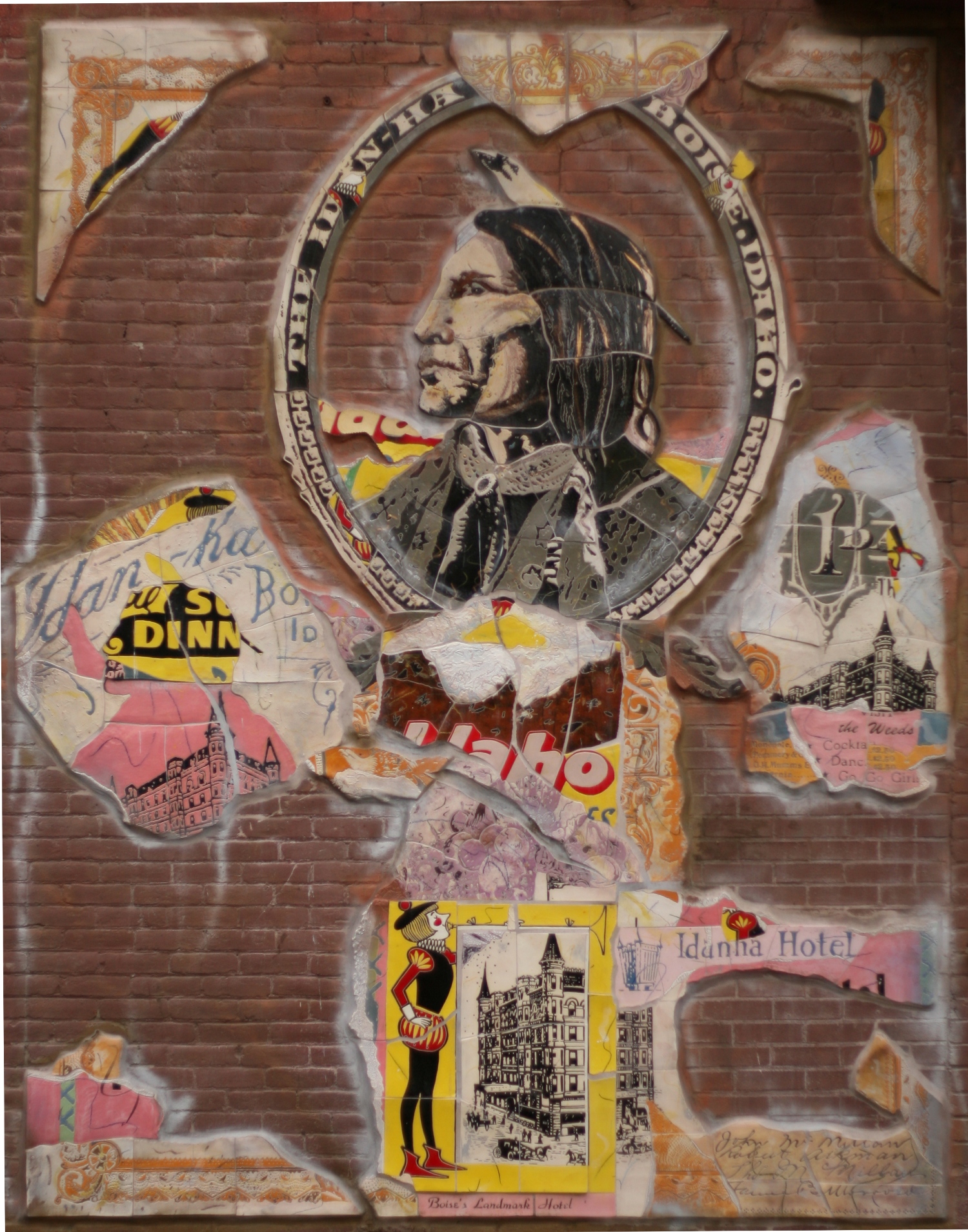
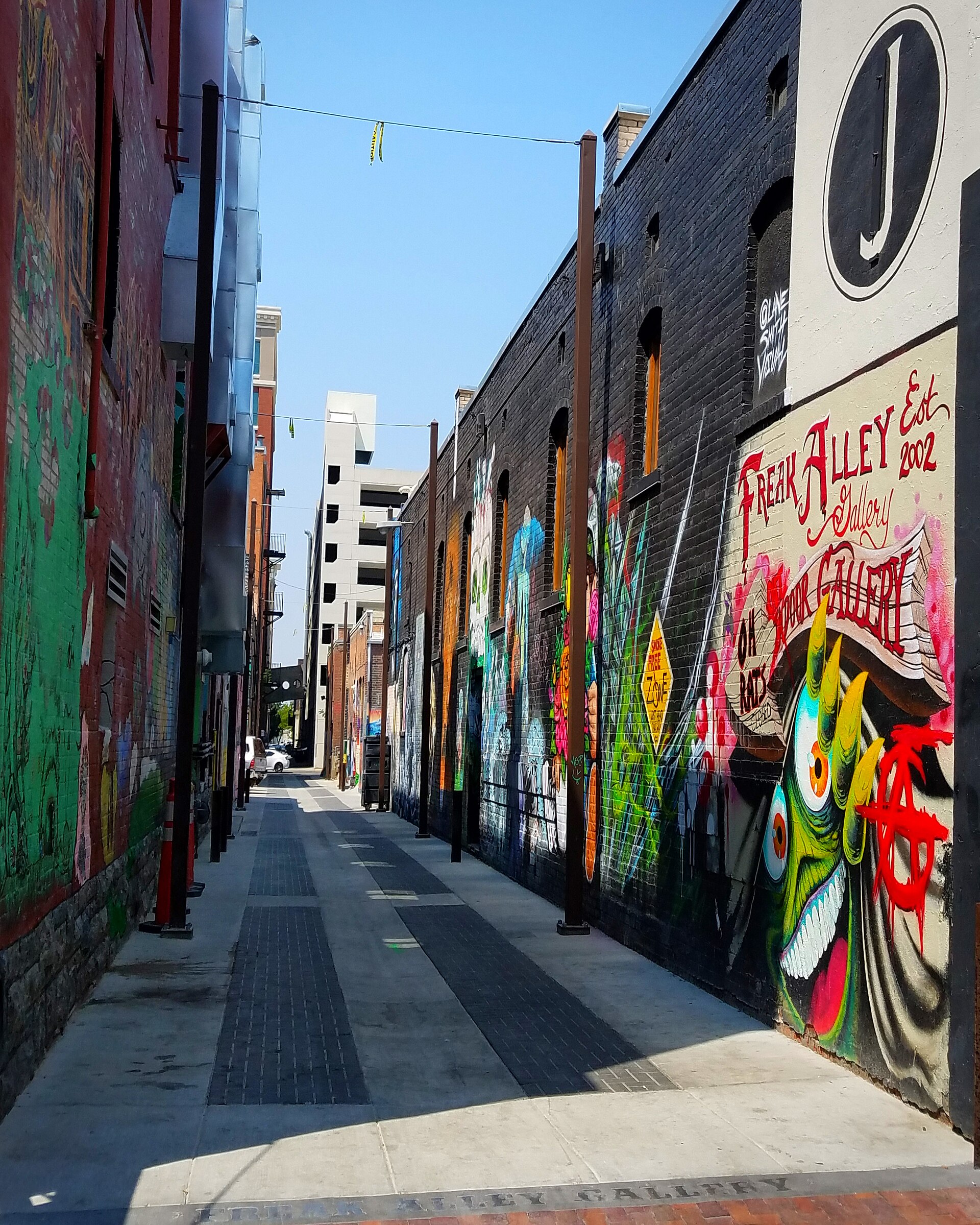
Freak Alley Gallery is an open-air corridor of large-scale murals in downtown Boise, painted directly onto the brick and concrete walls of the buildings that back onto it. It is not a museum with a door or a ticket desk — it is a public alley, free to enter at any hour, with dozens of murals layered onto its surfaces over more than two decades.
Where is Freak Alley, and how do you find it?
Freak Alley runs through the block between 8th and 9th Streets in downtown Boise, connecting to Idaho Street near the heart of the city’s commercial core. It is an actual service alley — the kind of narrow, unglamorous passage that exists behind most downtown blocks — rather than a purpose-built art space, which is part of what makes it distinctive.
Because it sits within a few blocks of the Basque Block and the rest of downtown’s cultural cluster, it is easy to combine with a walk through the area covered in Access Boise’s landmarks and sights coverage, or with a stop at the Basque Museum and Cultural Center, a short distance away.
How did Freak Alley start?
Freak Alley Gallery’s own account, published on its website, traces the project’s origins to 2002, when a local coffee shop began allowing artists to paint the alley wall behind its building. What began as a single mural expanded, wall by wall, as neighboring business owners agreed to let artists work on their exterior walls as well. Over time the alley filled in almost completely, and repainting became routine rather than exceptional.
The gallery describes itself, on its own site, as the largest outdoor gallery in the Pacific Northwest — a claim made by the organization itself rather than by an independent body, and worth reading as self-description rather than an official ranking.
How does the gallery actually work?
There is no single curator selecting a fixed collection. Instead, Freak Alley operates as a rolling, participatory canvas: artists — local, regional, and sometimes traveling — apply or are invited to paint a section of wall, and murals are periodically painted over to make room for new work. A wall that shows one image one year may show something entirely different a few years later.
This means a few things for anyone trying to understand the space:
- The murals are not permanent or archival in the way a museum collection is. What is documented in photographs from a given year may no longer exist.
- There is no admission fee and no fixed opening hours, because it is a public alley rather than an enclosed venue.
- The work varies widely in style, from representational portraiture to abstract and text-based pieces, because it reflects the individual choices of many different artists over many years rather than a single artistic direction.

Is there a festival attached to it?
Freak Alley Gallery’s organizers have historically run an annual event, generally referred to as the Freak Alley Festival, timed to coincide with fresh mural painting and typically held in warmer months. Event details, including whether it runs in a given year and on what dates, change from season to season, so readers should confirm current information on the gallery’s own website rather than relying on a fixed date here.
The pattern is a useful one to understand even without exact dates: Boise’s downtown calendar tends to cluster public, free, walkable events in late spring and summer, when longer daylight and milder weather make outdoor programming practical. A mural festival in an alley fits that broader seasonal rhythm rather than standing apart from it.
Is Freak Alley free, and when is the best time to see it?
Yes. There is no admission charge, and the alley is accessible during daylight hours as a public passage, not a ticketed attraction. Because the murals are painted on exterior walls, visibility depends on natural light rather than any posted operating hours — an overcast winter afternoon looks very different from a bright summer morning.
Anyone comparing this to Boise’s ticketed institutions should note the difference in kind, not just in price. Access Boise’s guide to which Boise museums are free, and when covers indoor collections with their own free-admission windows; Freak Alley simply has no gate to begin with.
How does Freak Alley fit into Boise’s broader arts scene?
Downtown Boise carries a formal, curated art institution in the Boise Art Museum, which holds and exhibits a permanent collection under professional stewardship. Freak Alley sits at the opposite end of that spectrum: unmanaged in the curatorial sense, continuously overwritten, and owned collectively by the building owners and artists who maintain it rather than by any single institution.
Both are part of the same broader picture covered in Access Boise’s museums and galleries archive, which tracks how the city’s art holdings — from a state-run museum collection to a volunteer-driven mural alley — are organized very differently from one another, even within a few blocks of downtown.
Does the mural content change in a documented way?
Not through any official public register. Because murals are repainted informally as walls become available and artists are recruited, there is no single authoritative catalogue of every mural that has existed in the alley since 2002. Photographs circulated by past visitors, local press coverage, and the gallery’s own social media are the closest thing to a running record, and none of them constitute a complete archive.
This is worth knowing before visiting with a specific mural in mind from an old photograph or article: the wall in question may no longer carry that image.
What should a resident know that a visitor might not?
For people who live in Boise, Freak Alley functions less as a destination and more as a piece of downtown’s everyday texture — a shortcut between streets that happens to be painted. Its content shifts slowly enough that longtime residents can watch it change across years rather than days, and its informal governance means the alley’s look at any given moment reflects whichever local business owners and artists have been active recently, not a fixed civic plan.
That informality is also its limitation as a source: there is no government body, historical society, or museum authority overseeing Freak Alley’s content, so claims about its history, scale, or standing should be traced to the gallery’s own published material rather than treated as independently verified fact.
What else is nearby worth knowing about?
Downtown Boise concentrates several institutions within easy walking distance of the alley, each documented with its own durable facts rather than mood. The Idaho State Capitol and the Idaho State Archives sit within the same general downtown core, and both are covered in detail elsewhere on Access Boise for readers building out a fuller day around the city center.
Freak Alley itself remains the simplest of these to describe: a working alley, painted over repeatedly since 2002, free to enter, and governed by no fixed schedule beyond daylight.
Access Boise is an independent guide written from published, checkable sources. We have not visited the places described here and we do not publish personal recommendations or invented ‘local favourites’ — where something is singled out as notable, we say who says so. Opening times, fares, closures and prices change at short notice, so treat everything here as a starting point and confirm with the museum, operator or venue directly before building a day around it. We give no advice on visas, insurance, health or safety; use your own government’s official guidance for those.
Featured image: Photo by DieselDemon, source, CC BY 2.0
