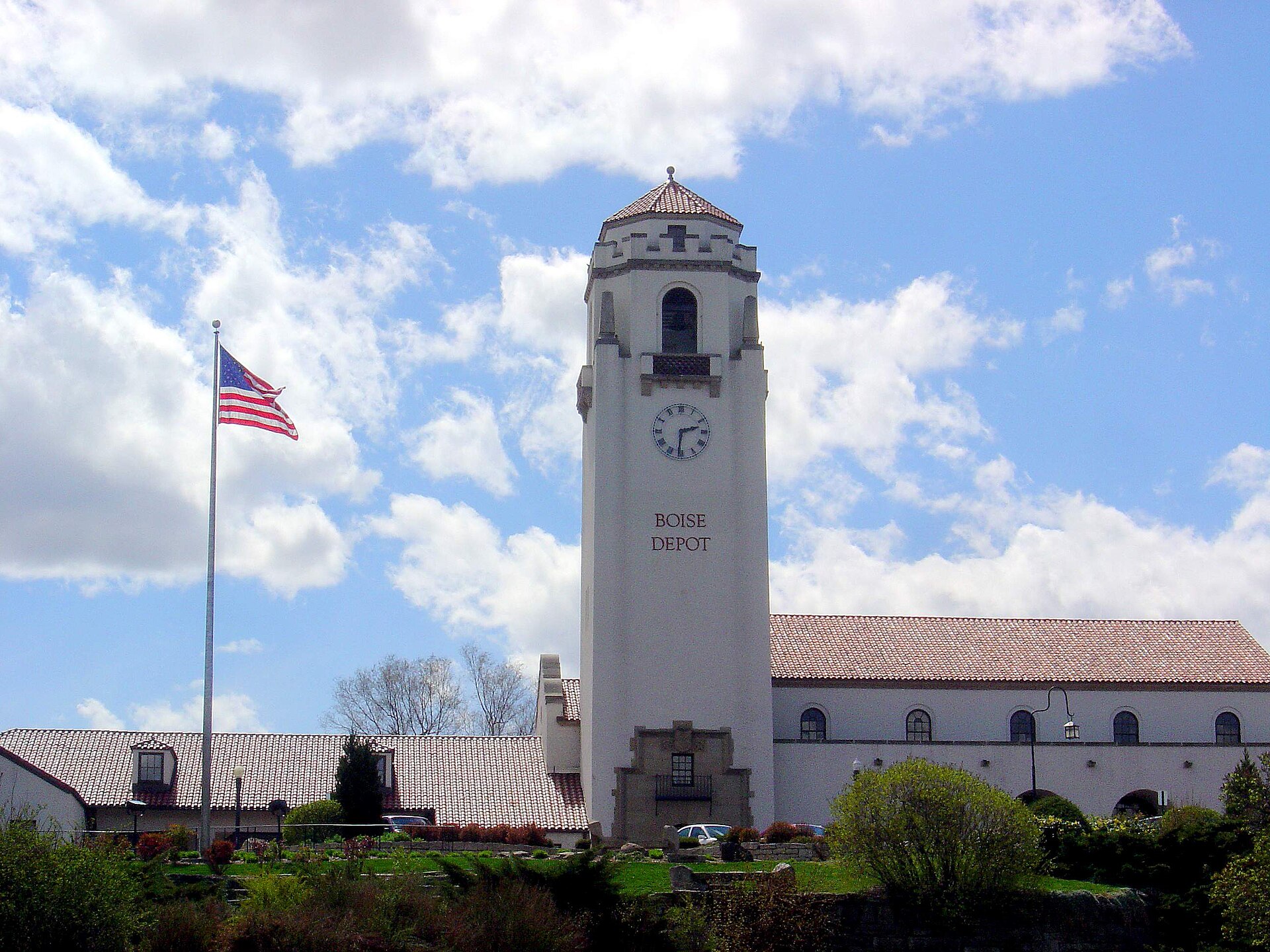
The Boise Depot is the former Union Pacific passenger station built in 1925 on the bench south of downtown, known for its Spanish Mission Revival bell tower. Platt Gardens is the formal, city-maintained lawn and garden that surrounds the depot building and terrace. Together they form one landmark site: a historic building set inside a public park.
What is the Boise Depot?
The Boise Depot — sometimes called the Boise Union Pacific Depot — was built by the Union Pacific Railroad and opened in 1925 to serve as Boise’s main passenger rail station. It sits at the top of Capitol Boulevard, on a rise overlooking the Boise River and downtown, and is easily identified by its tall, Spanish-style tower and arcaded facade. The building is listed on the National Register of Historic Places. A fuller account of its design, materials and construction history is covered separately in this site’s guide to the Boise Depot’s history and architecture.
What is Platt Gardens?
Platt Gardens is the name given to the landscaped grounds immediately in front of and below the depot’s terrace, maintained as public parkland by the city of Boise. It consists of open lawns, mature trees, seasonal plantings and paved walkways arranged around a central plaza, with the depot building forming its backdrop. It functions as a neighborhood park in its own right, distinct from the depot’s interior, and is open to the public with no admission charge, in the manner of other city green spaces covered in the Parks & Foothills archive.
Is the Boise Depot still a working train station?
No. The depot no longer functions as a scheduled passenger rail stop. Amtrak’s Pioneer route, which once called at Boise, was discontinued in the 1990s, and no regular passenger service currently uses the building. The tracks below the depot still carry freight traffic, but the station itself has been repurposed as a civic and event building owned and operated by the city of Boise rather than a functioning transit terminal.
Can you go inside the depot?
The depot building is used by the city primarily as a rental venue for weddings, receptions and civic events, and public access to the interior is tied to that schedule rather than to fixed visitor hours. Because availability, rental terms and any open-house dates change, readers should confirm current access through the city of Boise’s own parks and facilities listings rather than relying on a fixed schedule here. The surrounding grounds of Platt Gardens, by contrast, are open to the public as ordinary park space during daylight hours.
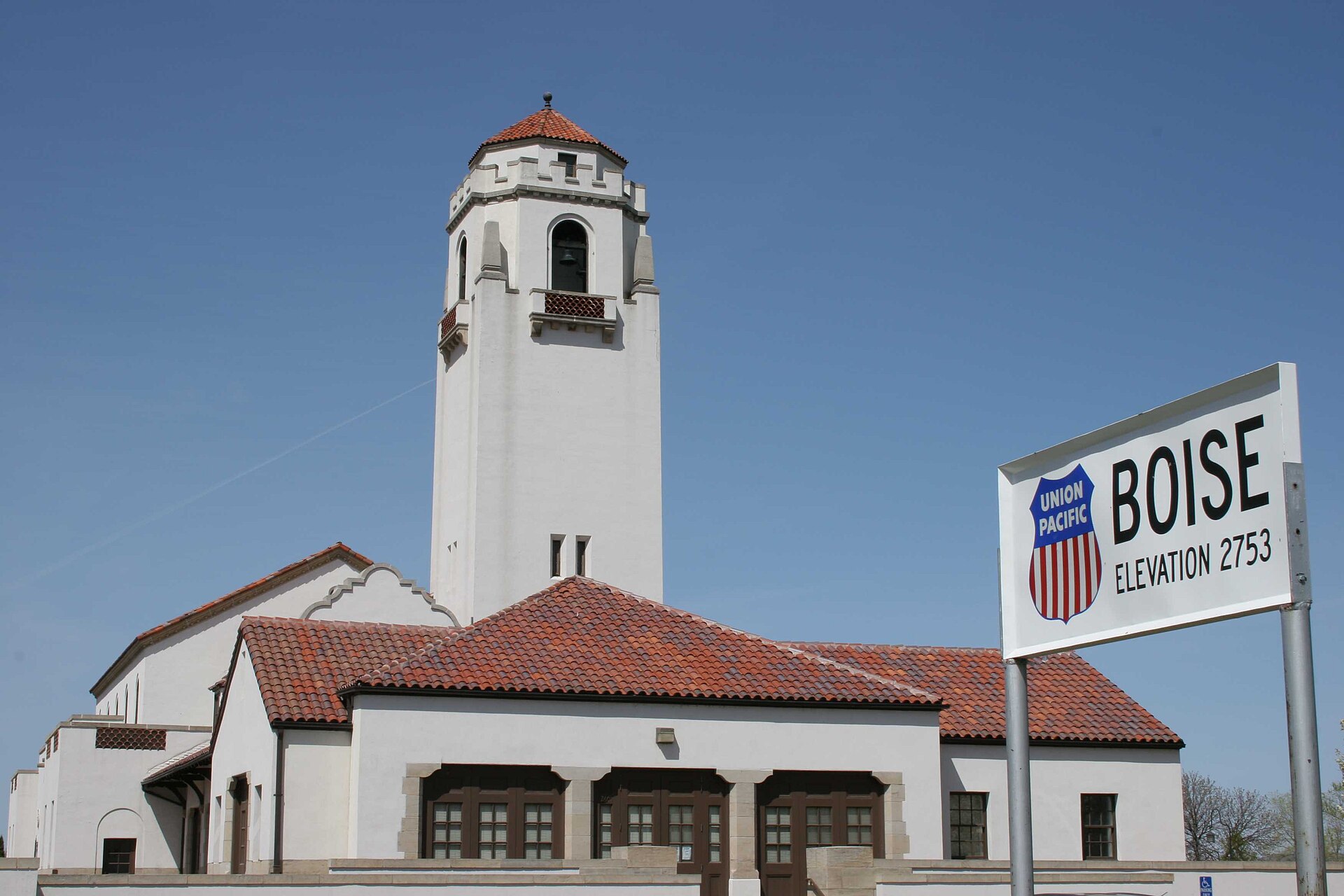

What is the view from the depot plaza?
The depot’s front terrace and Platt Gardens sit at the elevated south end of Capitol Boulevard, which was laid out to create a direct sightline between the depot and the Idaho State Capitol several blocks north. Standing at the depot plaza, the dome of the Capitol is visible down the length of the boulevard — a deliberate piece of early-twentieth-century city planning rather than a coincidence of geography. Readers looking to understand the building at the other end of that sightline can consult this site’s own guide on visiting the Idaho State Capitol.
How do the gardens get used through the year?
Platt Gardens functions as an open lawn and plaza year-round, and its use shifts with Boise’s seasonal calendar rather than following a fixed programme. In warmer months the grounds see picnicking, wedding photography, and casual foot traffic connecting downtown to the Boise River Greenbelt below; in winter the open lawn and tower make it a quieter, largely passive space. The depot building itself hosts private events on a rental basis throughout the year, and any public gatherings or seasonal displays tied to the site should be checked against the city of Boise’s current listings rather than assumed from past patterns.
How do you get to the Boise Depot?
The depot sits at the south end of Capitol Boulevard, on a bluff above the Boise River, a short distance from downtown by car, bicycle or on foot. The Boise River Greenbelt, the shared-use path that follows the river through the city, passes near the base of the bluff below the depot, giving pedestrians and cyclists a direct route to the site without going through downtown streets. There is no rail or streetcar service to the building itself, since it is no longer an active station; visitors arrive by road or trail rather than by train.
Where does the Boise Depot fit among Boise’s landmarks?
The depot is one of the city’s most recognizable pieces of early-twentieth-century architecture and is regularly grouped with the Idaho State Capitol among Boise’s principal civic landmarks, largely because of the intentional sightline between the two buildings. It differs from most entries in the Landmarks & Sights archive in that it is not a museum with a collection to view, but a building-and-grounds combination: an architectural landmark paired with a working public park. Readers comparing it to Boise’s other landscaped public grounds, such as the plantings on the former penitentiary grounds described in the guide to the Idaho Botanical Garden, will find Platt Gardens smaller and more formal — a civic plaza rather than a horticultural collection.
Is there a museum connection at the depot?
The depot is not itself a formal museum with regular public hours, and it should not be confused with Boise’s collecting institutions. Readers interested in the city’s broader museum landscape, including which sites offer free or reduced-cost access on set days, can consult the separate guide to which Boise museums are free, and when. The depot’s historical significance is documented instead through its National Register listing and through city and state historical records rather than through an on-site permanent exhibition.
What should a visitor actually expect on arrival?
A visitor arriving at the Boise Depot should expect an exterior architectural landmark and an open public garden rather than a staffed visitor center. The tower, arcades and terrace can be viewed and photographed from the surrounding grounds at any reasonable hour, and Platt Gardens can be walked freely as ordinary park space. Interior access depends entirely on whether an event is booked through the city, so anyone hoping to see inside the building should check the city of Boise’s own facility-rental information in advance rather than assume walk-in access.
Access Boise is an independent guide written from published, checkable sources. We have not visited the places described here and we do not publish personal recommendations or invented ‘local favourites’ — where something is singled out as notable, we say who says so. Opening times, fares, closures and prices change at short notice, so treat everything here as a starting point and confirm with the museum, operator or venue directly before building a day around it. We give no advice on visas, insurance, health or safety; use your own government’s official guidance for those.
Featured image: Photo by No machine-readable author provided. Cutlerite~commonswiki assumed (based on cop, source, CC BY 2.5
