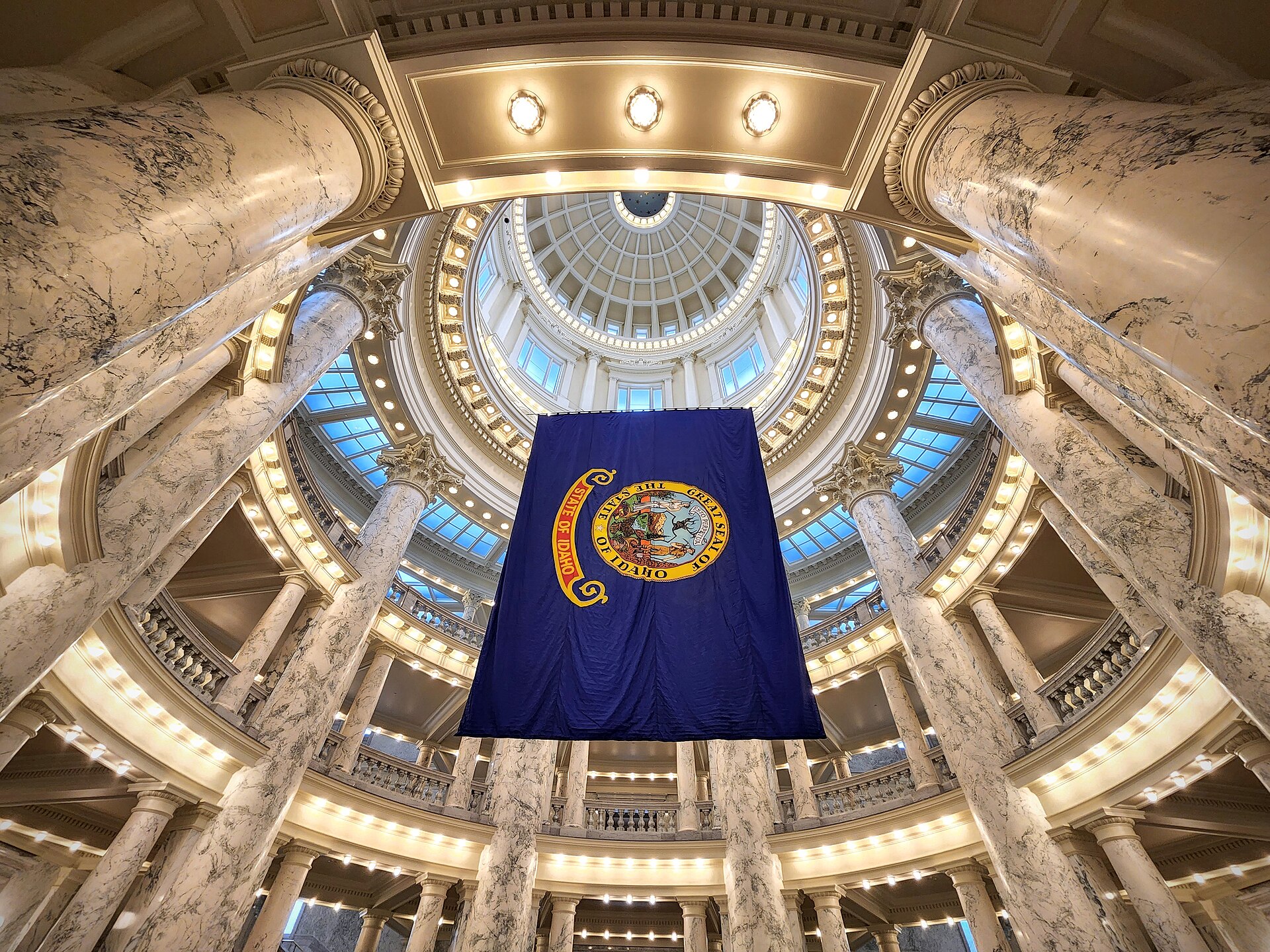
The Idaho State Capitol is the seat of Idaho’s state government in downtown Boise, a domed sandstone building completed in stages between 1905 and 1920. It is heated by geothermal water because Boise sits above a natural hot-water aquifer, and the state taps that heat directly through a dedicated well and pipe system rather than burning fuel to make steam. The Capitol is the only state capitol in the country heated this way.
What is the Idaho State Capitol?
The Capitol is Idaho’s working statehouse, housing the governor’s office, the state legislature, and the Idaho Supreme Court’s ceremonial chamber. Construction ran in two main phases: the central rotunda and dome, built 1905–1912, and the east and west wings, added 1919–1920 to house the House and Senate. The building is listed on the National Register of Historic Places, which documents its design and construction history in detail.
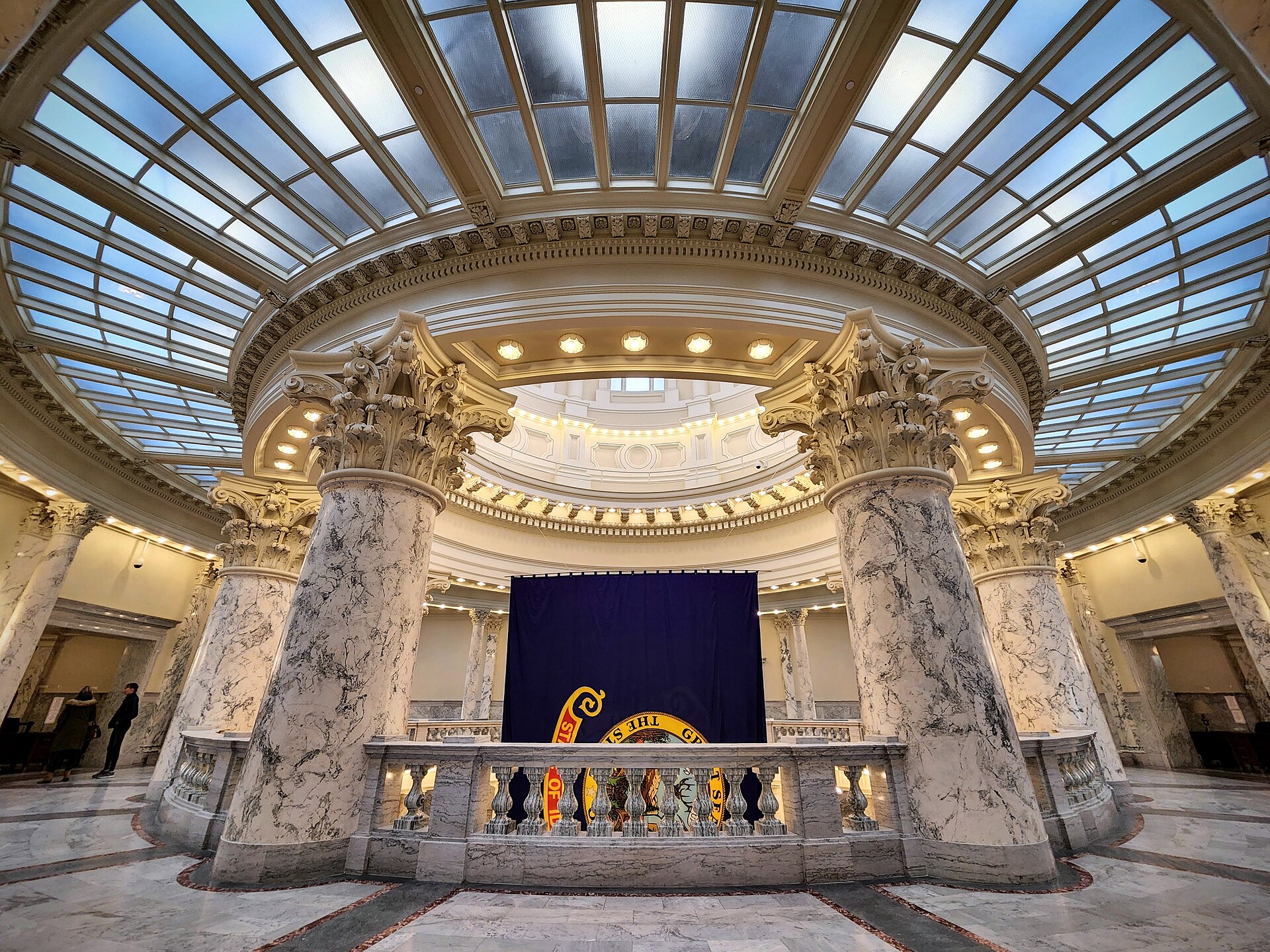
The architects, John E. Tourtellotte and Charles Hogan, designed the building in a Beaux-Arts style common to American statehouses of the period, but with a distinctly regional material: sandstone quarried from Table Rock, a bluff on Boise’s eastern edge overlooking the Boise River. That stone is visible on the building’s exterior and also inside, alongside four types of imported marble — from Vermont, Georgia, Alaska and Italy — used in the columns and floors of the rotunda.
A major renovation completed in 2010 added two below-grade wings extending east and west from the historic structure, giving the legislature modern hearing rooms and offices while leaving the original building’s exterior and rotunda largely untouched. The project also restored much of the original interior finishing, including the skylight over the rotunda, according to the state’s own project documentation from the renovation period.
Why is the Capitol heated by geothermal water?
The Capitol draws heat from a system of wells sunk into a hot-water aquifer that lies beneath Boise’s foothills and downtown. Water comes up already hot — geothermal wells in the area typically produce water well above room temperature — and is circulated through the building’s heating system before being returned underground. No boiler burning gas or oil is needed to heat the building through Idaho’s winters.
This is not a novelty added for modern sustainability branding. Boise has used geothermal water for heating since the 1890s, making it one of the oldest geothermal district heating cities in the United States. The Capitol was connected to a dedicated geothermal system serving state buildings on Capitol Mall in the 1970s, a project undertaken by the state as fuel costs rose sharply that decade and geothermal water offered a stable, locally available alternative.
The system is separate from the city’s downtown municipal geothermal network and from the Boise Warm Springs Water District, an older cooperative system serving homes in the city’s Warm Springs neighborhood. Idaho has three distinct geothermal heating systems operating in and around downtown Boise, each drawing from different wells and serving different customers — state buildings, city-owned buildings, and private homes respectively.

How does Boise’s wider geothermal system work?
Geothermal heating in Boise depends on an aquifer that holds naturally heated water close enough to the surface to be reachable by wells, rather than on volcanic activity or geysers of the kind associated with geothermal power elsewhere. Wells draw hot water up, heat exchangers transfer that warmth into building heating loops, and the cooled water is returned to the aquifer through injection wells — a closed-loop process intended to sustain the resource rather than deplete it.
The City of Boise operates its own geothermal system serving municipal and private buildings downtown, and describes the mechanics of the process, including well locations and the injection-return principle, on its public works pages. For a broader public explanation of how geothermal and other water systems work in the Boise Valley, the Boise WaterShed education center covers the underlying hydrology in exhibits built for a general audience, including how groundwater and geothermal resources relate to the city’s overall water supply.
For residents, the practical result is that a cluster of downtown buildings — public and private — run on heat that never touches a gas line. For visitors, the detail is easy to miss entirely, since geothermal heating leaves no visible infrastructure at street level; the pipes run underground and the wells are unobtrusive.
What does the Capitol building itself contain?
Beyond its legislative chambers, the Capitol includes public displays related to Idaho’s state government and history, and its rotunda is generally open to the public during state office hours, subject to security screening — details worth confirming on the state’s own Capitol visitor information before planning a visit around it.
The building sits at the center of Boise’s Capitol Mall, a cluster of government and cultural buildings. Two are especially relevant to visitors interested in state history:
- The Idaho State Museum, which holds the state’s primary historical collection and sits a short walk from the Capitol steps.
- The Idaho State Archives, which holds the public records — including materials related to the Capitol’s own construction and renovation — available for research under the Archives’ own access rules.
Together, the Capitol, the State Museum, and the Archives form a compact civic core that explains a good deal of how Idaho’s state government documents and displays its own history, distinct from the city’s broader museum scene covered in the Museums & Galleries section of this site.
Why does the geothermal detail matter to how Boise works?
The Capitol’s geothermal heating is often presented as a curiosity — the “only state capitol in the world” heated this way, a line repeated in state tourism material and by the Idaho State Historical Society. But the more useful way to understand it is as one visible example of a resource Boise has used continuously for well over a century, largely without fanfare, because the geology happens to make it available.
That continuity matters for how the city thinks about infrastructure. Boise’s geothermal systems predate almost every other piece of the city’s modern utility network, and they’ve expanded gradually rather than through a single dramatic project. The Warm Springs district’s system, the city’s downtown network, and the Capitol Mall system each grew from local, incremental decisions to use water that was already there rather than import fuel.
For a visitor standing on the Capitol steps, none of this is visible. The building reads as a conventional early-20th-century statehouse — sandstone, a dome, a rotunda faced in marble. The heating system is the part of the building’s story that has to be told rather than seen, which is precisely why state and local sources treat it as worth explaining rather than leaving as a footnote.
How does the Capitol compare to Boise’s other landmark buildings?
The Capitol is one of several Boise buildings from the same architectural period that combine imported materials with regional stone and, in some cases, unusual engineering choices. The Boise Depot, built a few years after the Capitol’s wings were completed, is another example of a landmark structure whose design tells a specific story about the city’s growth — in that case, the railroad’s role in shaping Boise rather than geothermal geology.
Readers interested in how Boise’s historic landmarks fit together as a category — rather than as isolated stops — can find a fuller list in the Landmarks & Sights archive on this site, which covers the Capitol alongside the city’s other National Register-listed and municipally significant buildings.
What should a visitor check before going?
Public access to the Capitol, security procedures, and any interior tours are set by the state and can change with legislative sessions, security requirements, or renovation work. The Idaho Legislature’s own website and the Idaho Department of Administration, which manages the Capitol building, are the current sources for opening hours and access rules — this article does not stand in for either.
Readers visiting the wider Capitol Mall area on the same trip may also want to check current hours for the Idaho State Museum and the State Archives separately, since each operates on its own schedule distinct from the Capitol itself.
Access Boise is an independent guide written from published, checkable sources. We have not visited the places described here and we do not publish personal recommendations or invented ‘local favourites’ — where something is singled out as notable, we say who says so. Opening times, fares, closures and prices change at short notice, so treat everything here as a starting point and confirm with the museum, operator or venue directly before building a day around it. We give no advice on visas, insurance, health or safety; use your own government’s official guidance for those.
Featured image: Photo by NateBergin, source, CC BY 4.0
