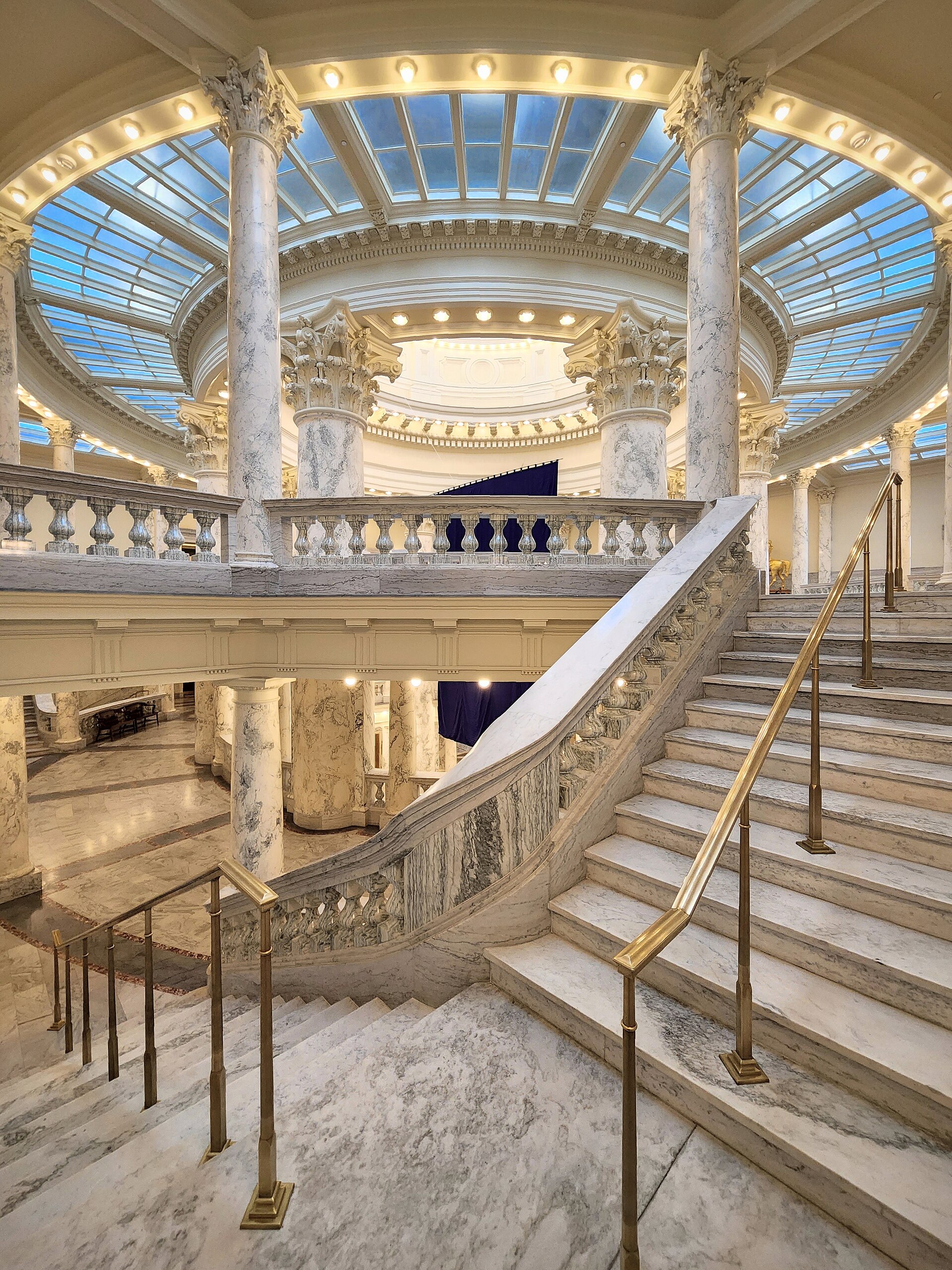
Can you go inside the Idaho State Capitol?
Yes. The Idaho State Capitol is a working government building open to the public free of charge during business hours, and its rotunda, four legislative wings, and public galleries can all be walked through on a self-guided basis. There is no admission fee and no requirement to book ahead, though visitors pass through security screening on entry, as the Idaho Legislature’s own site notes.
Where is it, and what does the building look like from outside?
The Capitol stands at the head of Capitol Boulevard in downtown Boise, the axis around which the city’s grid was laid out. It anchors the Capitol Mall Historic District, and the building itself is individually listed on the National Register of Historic Places.
Construction ran in phases between 1905 and 1920, and the exterior is built from sandstone quarried at Table Rock, a bluff visible from much of the city’s east side. The Idaho State Historical Society records that the sandstone came from the same source used for the earlier Old Idaho Penitentiary buildings a short distance away, which makes the two sites materially related even though they serve entirely different functions.
What is inside the rotunda?
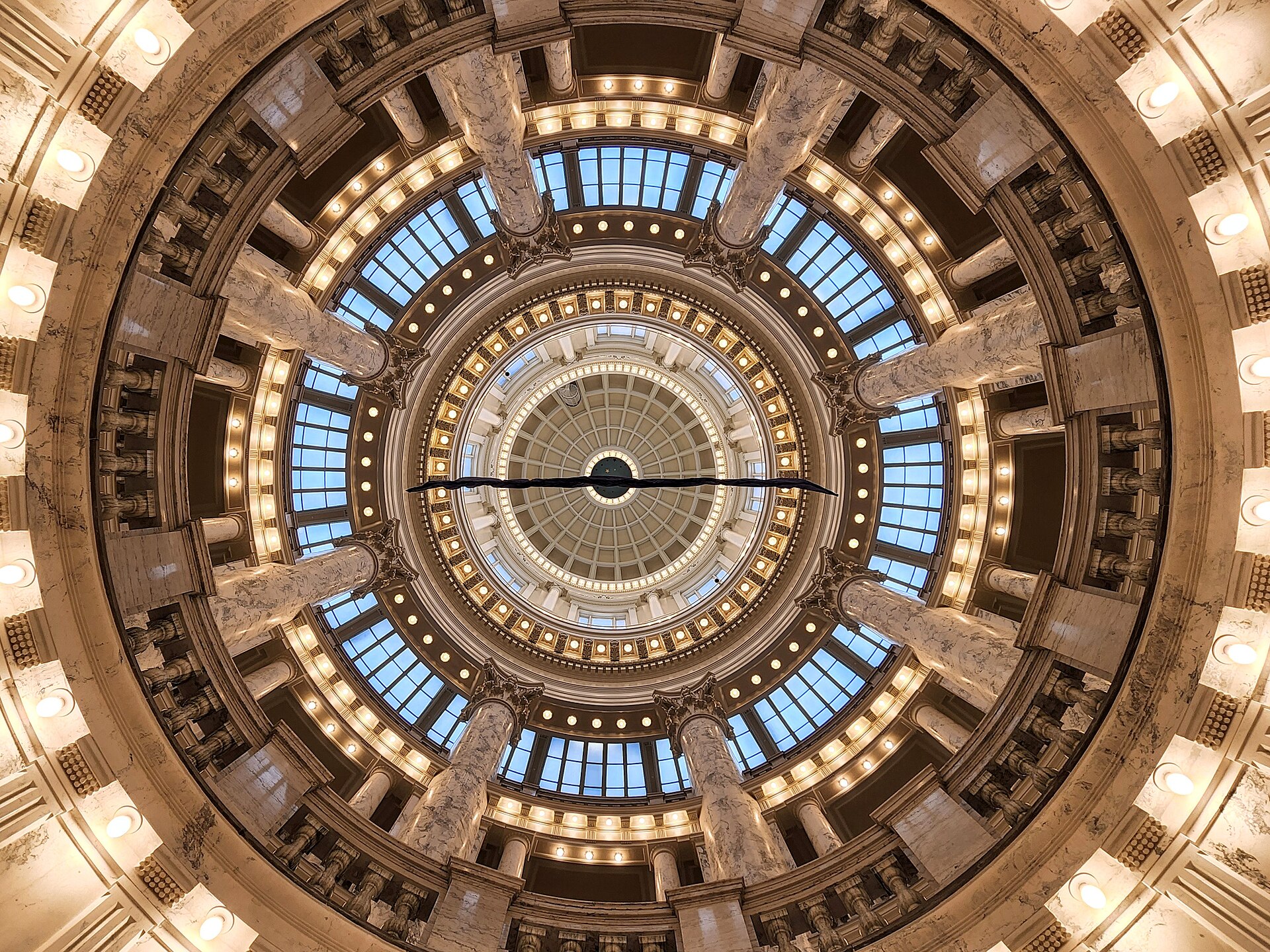
The rotunda is the building’s central atrium, rising through four floors beneath a stained-glass dome. Columns and stair balustrades are finished in marble sourced, according to the Idaho Legislature’s own building guide, from four separate locations — Alaska, Vermont, Georgia, and Italy — a detail the Legislature itself highlights as unusual for a state capitol of this size.
A bronze statue of George Washington on horseback, carved originally in wood and later cast in bronze, stands on the main floor; it predates the current building and was moved into it after completion. Flags, historical portraits, and rotating displays occupy the ground-floor galleries, and the building’s own visitor materials describe these as changing periodically rather than fixed.
What happened in the 2007–2009 renovation?
The Capitol closed for a multi-year restoration and expansion completed in 2009, during which two underground wings were added to house expanded House and Senate committee space without altering the historic exterior. The Idaho Department of Administration, which oversaw the project, describes the work as a restoration rather than a redevelopment — original finishes, skylights, and the rotunda’s proportions were retained, while mechanical and accessibility systems were brought up to current code underground, out of sight.
That renovation is also when the building’s geothermal heating system was upgraded and formalized. The Capitol draws on the same geothermal aquifer used elsewhere in downtown Boise, and it is frequently cited, including by the state’s own facilities office, as the only U.S. state capitol heated this way. The building, history, and mechanics of that system are covered in more detail in Access Boise’s separate piece on the Capitol’s building history and geothermal heating.

Can you visit the legislative chambers?
Yes, when the Legislature is not in a closed session. The House and Senate chambers sit on the third and fourth floors of the east and west wings, and public galleries above each chamber allow visitors to watch proceedings when the Legislature is in session, which the Idaho Legislature’s own calendar publishes annually. Outside of session, the chambers themselves can typically still be viewed from the gallery or floor level as part of a self-guided walk, though this depends on legislative business and should be confirmed on the Legislature’s own site before a visit built around seeing a specific chamber.
The Idaho Supreme Court’s original courtroom, used before the judiciary moved to its own building, is also inside the Capitol and is sometimes opened for tours, per the Legislature’s visitor guidance.
Is there a guided tour, or is it self-guided only?
The Idaho Legislature’s own visitor information describes the standard experience as self-guided, with printed floor guides and interpretive panels placed throughout the building identifying murals, statuary, and the function of each wing. Guided tours for school groups and organized parties are arranged separately through the Legislature’s office, and the operator’s own site is the correct place to confirm current tour scheduling, group size limits, and any seasonal changes to public hours, since these details are not fixed year to year.
What else is worth seeing while inside the building?
- The dome viewed from the fourth-floor gallery, which gives the clearest sightline up through the stained glass.
- Historical exhibits on Idaho statehood and territorial government, maintained on rotation by the Idaho State Historical Society.
- Memorial plaques and military service displays on the ground floor, which connect to the state’s broader military history holdings covered separately in Access Boise’s guide to the Idaho Military History Museum.
- The original Supreme Court chamber, when open, as noted above.
What is nearby, and does a Capitol visit combine well with anything else?
The Capitol sits within walking distance of several institutions that document related parts of Idaho’s public record. The Idaho State Archives, which holds the state’s original documents, territorial records, and government papers, is a short distance away and open to public researchers, as explained in Access Boise’s guide to the Idaho State Archives.
The Idaho State Museum, run by the Idaho State Historical Society, covers the broader sweep of state history and sits close enough to the Capitol Mall to combine into a single downtown visit; its holdings are described in Access Boise’s overview of the Idaho State Museum’s collection. For a wider view of what downtown Boise’s museums cover and which of them charge nothing at all, the site’s Museums & Galleries archive and its guide to which Boise museums are free, and when are useful starting points, since the Capitol’s own free admission is not unique in the district.
For readers building a broader itinerary of the city’s listed buildings and public monuments, the Landmarks & Sights archive covers other Register-listed sites, including the Boise Depot, another major public building from the same civic-building era whose architecture and history follow a similar arc of construction, use, and preservation.
What should residents know that a one-time visitor might not need?
For people who live in Boise, the Capitol functions less as a sight and more as a civic building that happens to be architecturally significant. Its public galleries are used for actual legislative business roughly half the year, on a schedule set by the Idaho Legislature and published on its own site, which means the building’s atmosphere, foot traffic, and gallery access shift markedly between session and interim periods.
Its geothermal system is also part of a citywide network, not a novelty specific to the Capitol — Boise’s downtown geothermal district heats a number of public and private buildings from the same aquifer, and the Capitol is simply its most visible participant. Residents researching the system in more depth, or comparing it with other geothermally heated public buildings in the city, will find the fuller mechanical and historical account in the site’s dedicated piece on the building’s geothermal heating.
Because the Capitol is a functioning government building rather than a museum, current hours, security procedures, and any temporary closures for legislative business are best confirmed directly on the Idaho Legislature’s own website before a visit, particularly for anyone planning to watch a session from the gallery.
Access Boise is an independent guide written from published, checkable sources. We have not visited the places described here and we do not publish personal recommendations or invented ‘local favourites’ — where something is singled out as notable, we say who says so. Opening times, fares, closures and prices change at short notice, so treat everything here as a starting point and confirm with the museum, operator or venue directly before building a day around it. We give no advice on visas, insurance, health or safety; use your own government’s official guidance for those.
Featured image: Photo by NateBergin, source, CC BY 4.0
