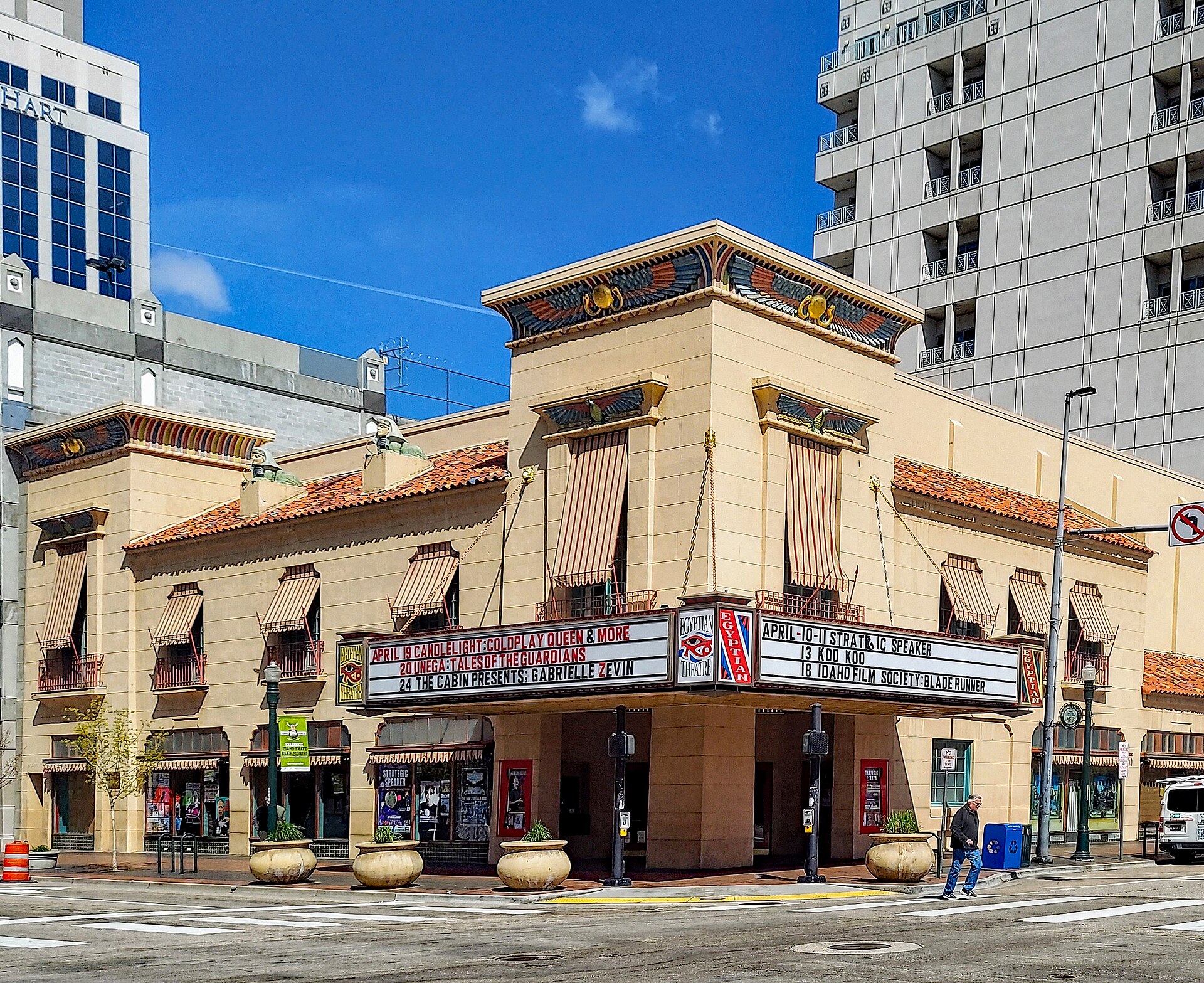
The Egyptian Theatre is a 1927 movie palace on Main Street in downtown Boise, built in the Egyptian Revival style that swept American architecture after the 1922 discovery of King Tutankhamun’s tomb. It is Egyptian because its owners deliberately borrowed that imagery — columns, winged sun disks, sphinxes — to sell a sense of exotic spectacle to moviegoers, not because of any historical link to Egypt itself.
What is the Egyptian Theatre, exactly?
It is a large single-screen theatre at the corner of Main and Capitol in downtown Boise, built as a first-run movie house in the last years of the silent-film era. Theatres of this scale and ornamentation were built across American downtowns in the 1920s to give moving pictures a setting as dramatic as the films themselves — a “movie palace,” in the industry term of the period.
The building has outlived that original purpose. It now functions as a live-event and screening venue, hosting concerts, film series and festival programming rather than a daily commercial cinema schedule. Its downtown location places it among the cluster of civic and cultural landmarks covered on Access Boise’s Landmarks & Sights pages.
Why did a Boise theatre get built in an Egyptian style?
The style traces directly to Howard Carter’s 1922 discovery of Tutankhamun’s tomb in the Valley of the Kings, an event that generated intense global press coverage and, within a few years, a fashion for Egyptian motifs in American consumer design — jewelry, furniture, and above all movie theatres. Boise’s building opened in 1927, squarely inside that wave.
Egyptian Revival theatres were built in cities including Los Angeles, Boise, and a scattering of other American downtowns during the mid-to-late 1920s, most of them designed to give an ordinary night at the pictures the feel of an expedition into an ancient, exotic world. The style had nothing to do with any regional connection to Egypt; it was borrowed decoration, applied because it was current and dramatic, in the same way earlier decades had produced Moorish and Spanish Colonial movie houses elsewhere in the country.
Idaho’s own architectural record shows this kind of imported revival style was not unusual for the period — the Idaho State Capitol, finished a decade earlier, borrowed its own vocabulary from classical Rome rather than the frontier West it actually sits in. Boise’s civic and commercial buildings of the early twentieth century were, in that sense, consistently looking outward for their architectural language.
What does the Egyptian styling actually look like on the building?
The exterior carries the recognizable vocabulary of the revival: a facade with battered (inward-sloping) piers suggesting Egyptian pylon gateways, a cornice treatment referencing temple architecture, and decorative elements drawing on winged sun-disk and lotus motifs common to Egyptian Revival design of the 1920s. Interior detailing extended the theme into the auditorium, with painted and sculpted ornament, including figures and patterning associated with ancient Egyptian imagery, applied throughout the lobby and house.
This was a common approach for movie palaces of the era generally: the architecture and interior decor worked together as a single themed environment, meant to be experienced as an event in itself before the film even started. Boise’s theatre is one of the relatively small number of Egyptian Revival theatres from that decade that has survived into the present largely intact, rather than being demolished, gutted, or converted beyond recognition — a pattern true of many American movie palaces of the period.
Is the Egyptian Theatre on the National Register of Historic Places?
Yes. The theatre is listed on the National Register of Historic Places, the federal inventory of buildings and sites recognized for historical or architectural significance, maintained by the National Park Service. Listing on the Register documents a building’s historical and architectural significance; it does not, by itself, restrict private use or guarantee public access, and readers wanting the theatre’s official documentation should consult the National Park Service’s National Register database directly.
The Idaho State Historical Society, the state agency responsible for tracking and interpreting Idaho’s historic properties, also maintains records on buildings of this kind across the state, and is a useful source for readers wanting the broader context of how Idaho’s early twentieth-century commercial architecture has been preserved.
What is the theatre used for today?
The building functions as a working venue rather than a static landmark. It is used for:
- Concerts and touring live music, including performances tied to Boise’s broader festival calendar
- Film screenings, including programmed classic-film series distinct from a standard cinema run
- Community and cultural events that make use of its scale and stage
Because it operates as an active venue rather than a museum with fixed hours, schedules and ticketing are set by the theatre’s own operators and by whichever promoter or organization is presenting a given event. Anyone planning to attend something specific should confirm dates, ticket prices and access details directly through the venue’s own current listings rather than relying on any fixed schedule, in keeping with how quickly live-event calendars change.
How does it fit into downtown Boise’s landmark buildings?
The Egyptian Theatre sits within walking distance of several of downtown Boise’s other notable structures, forming part of a compact historic core that rewards understanding as a group rather than as isolated stops. The Idaho State Capitol anchors the district a few blocks away, itself notable for its use of geothermal heating as much as its architecture. The Idaho State Archives holds the public records that document buildings like this one, including original permitting and ownership history for researchers who want primary sources rather than summary accounts.
Downtown’s mural-covered Freak Alley Gallery represents a much more recent, informal layer of the same downtown fabric — unplanned and constantly repainted, in direct contrast to the fixed, preserved ornament of the Egyptian Theatre. Together they illustrate how downtown Boise carries architectural and artistic layers from different decades within a few blocks of each other.
For readers building out a fuller sense of Boise’s civic architecture from the same period, the Boise Train Depot and Platt Gardens offers a comparable case: a landmark building whose style was also chosen deliberately, for reasons tied to the period rather than to any literal connection between Boise and the place its architecture references.
Why does this kind of borrowed architecture matter for understanding Boise?
The Egyptian Theatre is a useful corrective to any assumption that a city’s older buildings necessarily reflect its own regional history. Boise in the 1920s was a growing state capital whose builders, like those in comparable American cities, reached for whatever architectural language signaled ambition, glamour or novelty at the time — Egyptian Revival for a movie palace, classical Revival for a capitol, and later, entirely different vocabularies for civic buildings that followed.
Readers researching the city’s built history more broadly can find related coverage across Access Boise’s Museums & Galleries and Landmarks & Sights archives, which track how individual buildings — a depot, a capitol, a theatre — each carry their own explanation for why they look the way they do, rather than assuming any single regional style ties them together.
Access Boise is an independent guide written from published, checkable sources. We have not visited the places described here and we do not publish personal recommendations or invented ‘local favourites’ — where something is singled out as notable, we say who says so. Opening times, fares, closures and prices change at short notice, so treat everything here as a starting point and confirm with the museum, operator or venue directly before building a day around it. We give no advice on visas, insurance, health or safety; use your own government’s official guidance for those.
Featured image: Photo by P. Hughes, source, CC BY-SA 4.0
