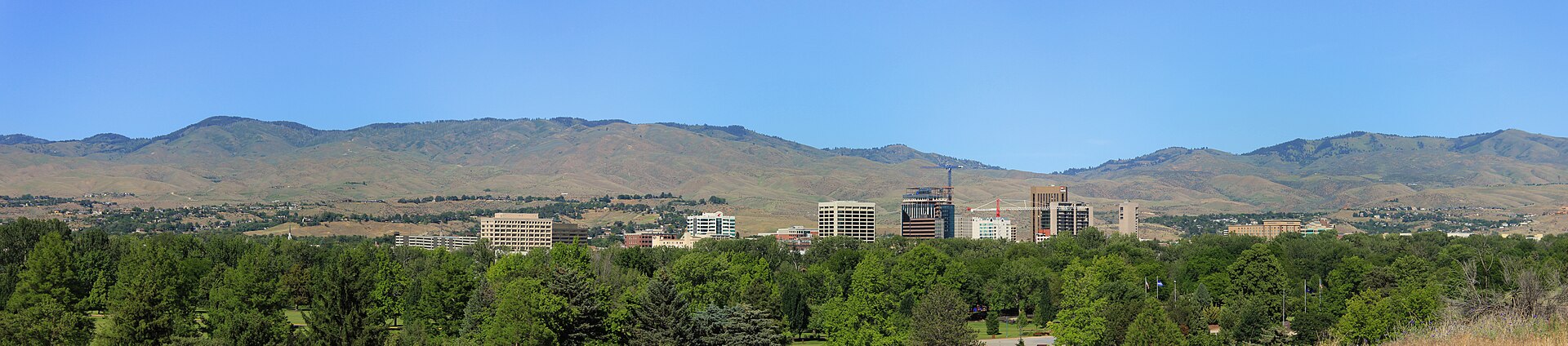
Boise’s smoke season is the stretch of late summer and early fall — typically late July through September, sometimes bleeding into early October — when wildfire smoke from fires burning across Idaho, eastern Oregon, and the broader Northwest settles into the Treasure Valley and degrades air quality for days or weeks at a time.
It is not a fixed calendar event like a festival. There is no start date printed anywhere. It is a pattern tied to fire activity elsewhere in the region, and some years it barely registers while others bring stretches of visibly orange skies and air quality advisories that last for weeks.
Why does Boise get wildfire smoke at all?
Boise sits in a dry intermountain basin downwind of some of the most fire-prone terrain in the American West — central Idaho’s forests, the Oregon high desert, and, depending on the year, fires as far off as Washington, Montana, or British Columbia. Smoke doesn’t need a local fire to affect the city; it travels in the upper atmosphere and settles into the valley the same way winter inversion traps cold air, a phenomenon explained in more detail on this site’s guide to Boise’s winter inversion.
The city’s own dry climate compounds this. As covered in the site’s piece on Boise’s elevation and dry air, the region gets little summer rainfall, which means there is nothing to wash smoke particles out of the air once they arrive. A smoke event can sit over the valley for days without a storm to clear it.
When does smoke season typically start and end?
Most years, noticeable smoke impacts begin sometime between mid-July and mid-August and can persist, with breaks, into late September. The exact window shifts year to year because it depends on where fires are burning and which way the wind is blowing, not on a Boise-specific trigger.
The National Interagency Fire Center, which is headquartered in Boise and coordinates wildfire response across federal and state agencies nationwide, publishes seasonal outlooks that track above-normal and below-normal fire potential by region — a useful proxy for how bad a given summer is likely to be for smoke, even though the center’s mandate is firefighting logistics rather than air quality forecasting.
Because the timing is genuinely variable, this site’s broader guide to when to visit Boise treats smoke as a real but unpredictable late-summer factor rather than a date to avoid outright.
How is Boise’s air quality actually measured?
Air quality during smoke events is tracked through the Air Quality Index (AQI), a standardized scale used across the United States. Two sources cover Boise specifically and are the ones worth checking directly rather than relying on visual judgment of the sky:
- The Idaho Department of Environmental Quality operates air monitoring stations in the Treasure Valley and issues advisories when smoke pushes AQI into unhealthy ranges.
- AirNow.gov, run jointly by the U.S. Environmental Protection Agency and partner agencies, aggregates real-time AQI readings and is the standard national reference for current conditions and short-term forecasts.
Both are far more reliable than a hazy-looking horizon. Smoke that looks dramatic at sunset from a distance can register as moderate on the AQI scale, while a thin, unremarkable-looking haze can sometimes carry unhealthy particulate levels. The instruments, not the eye, are the source to check before making plans.
.jpg)
How does smoke interact with Boise’s summer heat?
Smoke season overlaps directly with the tail end of Boise’s hot, dry summer, described in detail in this site’s account of what a Boise summer is actually like. High pressure systems that produce Boise’s driest, hottest stretches are often the same systems that hold smoke in place over the valley rather than letting it disperse.
This means the worst air quality days tend to coincide with the least appealing days to be outdoors for heat reasons anyway — though the two are separate hazards and advisories should be checked independently rather than assumed to track each other exactly.
Does smoke affect the foothills and outdoor recreation?
Smoke reduces visibility and can make strenuous outdoor activity in the Boise foothills genuinely unpleasant or, on advisory days, something local health authorities recommend limiting, particularly for children, older adults, and people with respiratory conditions. Idaho DEQ’s public guidance during active advisories generally recommends reducing prolonged outdoor exertion rather than avoiding the outdoors entirely, and its own advisory pages are the source to check for current wording.
Landmarks with elevation and open sightlines — places like Table Rock above the city — are also where smoke is most visually obvious, since haze that might be subtle at street level becomes unmistakable when looking across the valley from height.
Does smoke change how the city operates day to day?
Smoke season doesn’t shut Boise down the way a major storm might elsewhere. Businesses, transit, and daily life continue. What changes is smaller and more incremental: outdoor events sometimes get rescheduled or scaled back, air-quality-sensitive residents adjust their exercise timing, and local news coverage shifts toward daily AQI reporting during the worst stretches.
For residents, this is one of the more practically important seasonal patterns to understand, alongside winter driving conditions and inversion — both covered in this site’s broader Living in Boise coverage. It is a recurring feature of the year here, not an emergency each time it happens, but it is also not something to dismiss on the days AQI readings are genuinely elevated.
Is Boise’s smoke season getting worse?
Multiple federal and state fire agencies, including the National Interagency Fire Center, have documented longer fire seasons and larger burned areas across the western United States over recent decades in their public reporting. Whether any single Boise summer is worse or milder than the last is a year-to-year question tied to specific fire activity, and readers wanting a rigorous answer should consult NIFC’s own seasonal outlooks and DEQ’s historical air quality data rather than anecdote.
What can be said with confidence is the shape of the pattern: a dry basin city downwind of fire-prone forest and desert terrain, with a summer weather pattern that tends to trap rather than clear smoke once it arrives. That combination is structural, not a one-off, and it is why smoke season shows up as a predictable seasonal feature even though its exact dates and severity are not.
How should someone plan around it?
The practical approach is the same for a visitor booking a trip and a resident planning an outdoor month: check current AQI on Idaho DEQ’s site or AirNow before committing to strenuous outdoor plans in the August–September window, and build in flexibility rather than assuming clear skies. For broader trip timing, the site’s guide to Boise’s best time to visit and its overview of getting around and planning in Boise cover how this fits alongside the city’s other seasonal factors — heat, winter inversion, and snow access to the foothills.
Access Boise is an independent guide written from published, checkable sources. We have not visited the places described here and we do not publish personal recommendations or invented ‘local favourites’ — where something is singled out as notable, we say who says so. Opening times, fares, closures and prices change at short notice, so treat everything here as a starting point and confirm with the museum, operator or venue directly before building a day around it. We give no advice on visas, insurance, health or safety; use your own government’s official guidance for those.
Featured image: Photo by SniperProgrammer, source, CC BY-SA 3.0

Related reading
Ski Areas Near Boise Compared: Drive Time, Vertical and Cost.