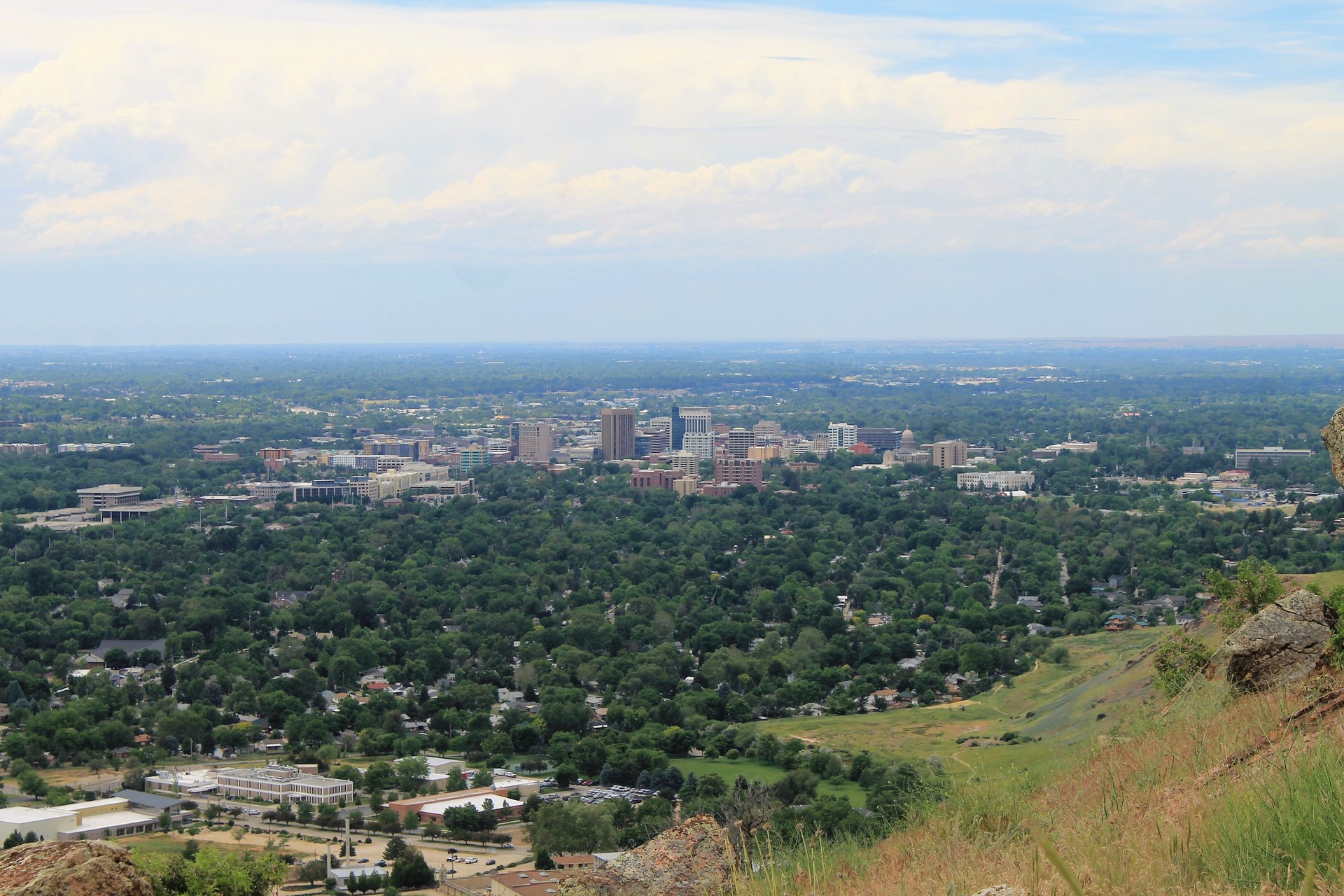
Table Rock is a sandstone mesa on the eastern rim of Boise’s foothills, rising directly above the Old Idaho Penitentiary and the Idaho Botanical Garden. Its flat summit holds a large illuminated cross, a cluster of television and radio transmission towers, and the exposed rock benches of a 19th-century quarry that supplied stone for several of the city’s landmark buildings.
What Is Table Rock?
Table Rock is a butte formed of sedimentary sandstone, part of the broader Boise Foothills that mark the edge of the Boise River valley. It sits east of downtown, visible from much of the city because it stands well above the surrounding bench land and the valley floor. The name describes its shape: a broad, level top rather than a peak, which is exactly what made it useful in the 19th century.
The mesa is a defining feature of Boise’s skyline in the way the river and the Capitol dome are — a fixed point of reference that residents use to orient themselves, and that shows up in photographs of the city taken from almost any direction.
Why Was Table Rock Quarried?
Table Rock is the source of the sandstone used to build two of Boise’s most significant historic structures. The Idaho State Historical Society and the National Register of Historic Places both document the quarry’s role in supplying building stone during the territorial and early statehood period.
- The Old Idaho Penitentiary, now a National Register-listed historic site, was built largely from sandstone quarried on and near Table Rock — in part by the labor of the prison’s own inmates.
- The Idaho State Capitol also drew on Table Rock sandstone for portions of its construction, alongside other Idaho stone.
Sections of the old quarry benches are still visible on the mesa’s flanks, with tool marks and cut faces left by the extraction process. The connection between the quarry and the buildings it produced is covered in more detail in the site’s pages on the Idaho State Capitol’s building and history and the Old Idaho Penitentiary’s history and visiting hours.
What Is on Top of Table Rock?
The summit holds three distinct things: a large illuminated cross, a set of broadcast transmission towers, and open ground that functions as a viewpoint over the city and the Treasure Valley.
The cross is the feature most visible from downtown Boise, particularly at night, when it is lit and can be seen from across the valley. Local news coverage in the Idaho Statesman has reported on its history and on the practice of changing its lighting for particular observances through the year; readers wanting the current arrangement should treat any specific detail as something to confirm rather than assume, since lighting schedules are not fixed public record.
The towers on Table Rock carry television and radio transmission equipment for the Boise market — a practical use of the site’s elevation and clear line of sight over the valley, similar to the reason many cities place broadcast infrastructure on their highest local terrain.
Beyond the cross and the towers, the top of the mesa is largely open rock and scrub, with informal viewpoints looking west over downtown Boise, the Boise River corridor, and on clear days the foothills and mountains beyond the valley.
Who Owns the Land on Table Rock?
Ownership on Table Rock is mixed rather than uniform, which is typical of Boise’s foothills generally. Portions of the mesa and surrounding foothill land fall under public management, including land connected to the city’s open-space and trail programs, while other parcels — including, by local reporting, the ground immediately beneath the cross — are privately held. There is no single agency that administers the entire summit, and the boundaries between public and private parcels are not something a visitor can read off the ground.
This patchwork ownership is one reason the site functions as a landmark and a hiking destination rather than a managed park with a single visitor center or admission point.
How Do People Get to the Top of Table Rock?
The most direct public access is on foot or by mountain bike, using the Table Rock Trail, which is part of the city’s Ridge to Rivers trail system. Ridge to Rivers is the city of Boise’s own foothills trail program, and its published trail information is the most reliable source for current routes, difficulty, and access points.
The trailhead area sits near the Old Idaho Penitentiary and the Idaho Botanical Garden, both of which occupy the historic penitentiary grounds at the base of the mesa. The climb gains a meaningful amount of elevation over a fairly short distance, which is why it is described locally as a workout hike rather than a stroll, and why it is popular in the cooler parts of the day during summer. There is also a road to the summit used for maintenance access to the towers; the public trail, not the service road, is the route described in the Ridge to Rivers system.
Anyone planning the hike should check the Ridge to Rivers program’s own site for current trail conditions, since foothills trails in Boise close periodically for mud, fire risk, or maintenance — a pattern covered more generally in the site’s guide to getting around Boise and planning a visit.
What Else Is Near Table Rock?
The base of the mesa sits inside a cluster of the city’s most-visited historic sites. The Old Idaho Penitentiary occupies the grounds directly below Table Rock and is itself built substantially from the mesa’s sandstone. Adjacent to it, the Idaho Botanical Garden now occupies part of the same former penitentiary property, using the historic stone walls and structures as a backdrop for its plant collections — a relationship described in the site’s article on the Idaho Botanical Garden and the old penitentiary grounds.
This cluster — quarry, prison, and garden — makes the base of Table Rock one of the more historically dense corners of Boise, even though the mesa itself has no visitor center, museum building, or formal entrance fee. For readers assembling a broader picture of the city’s historic sites, the site’s landmarks and sights archive and museums and galleries archive cover the buildings connected to Table Rock’s stone in more detail.
Why Does Table Rock Matter to Boise Today?
Table Rock functions less as a single attraction and more as a fixed point in how the city reads its own geography. Its silhouette and cross are visible from much of the valley floor, its trail is a regular fixture in how residents use the foothills for exercise, and its quarry history ties directly to two of the buildings most associated with Boise’s civic identity, the Capitol and the old territorial prison.
For a visitor, it is a straightforward hike with a view rather than a curated destination. For a resident, it is part of the everyday backdrop — a landmark used to orient a house, a photograph, or a run, and a foothills trail that gets folded into the wider seasonal pattern described in the site’s overview of what it is actually like to live in Boise. Both readings are accurate; Table Rock simply carries them at the same time.
Broader context on how the foothills trail system functions across the seasons, including closures and access patterns, is covered in the site’s parks and foothills archive.
Access Boise is an independent guide written from published, checkable sources. We have not visited the places described here and we do not publish personal recommendations or invented ‘local favourites’ — where something is singled out as notable, we say who says so. Opening times, fares, closures and prices change at short notice, so treat everything here as a starting point and confirm with the museum, operator or venue directly before building a day around it. We give no advice on visas, insurance, health or safety; use your own government’s official guidance for those.