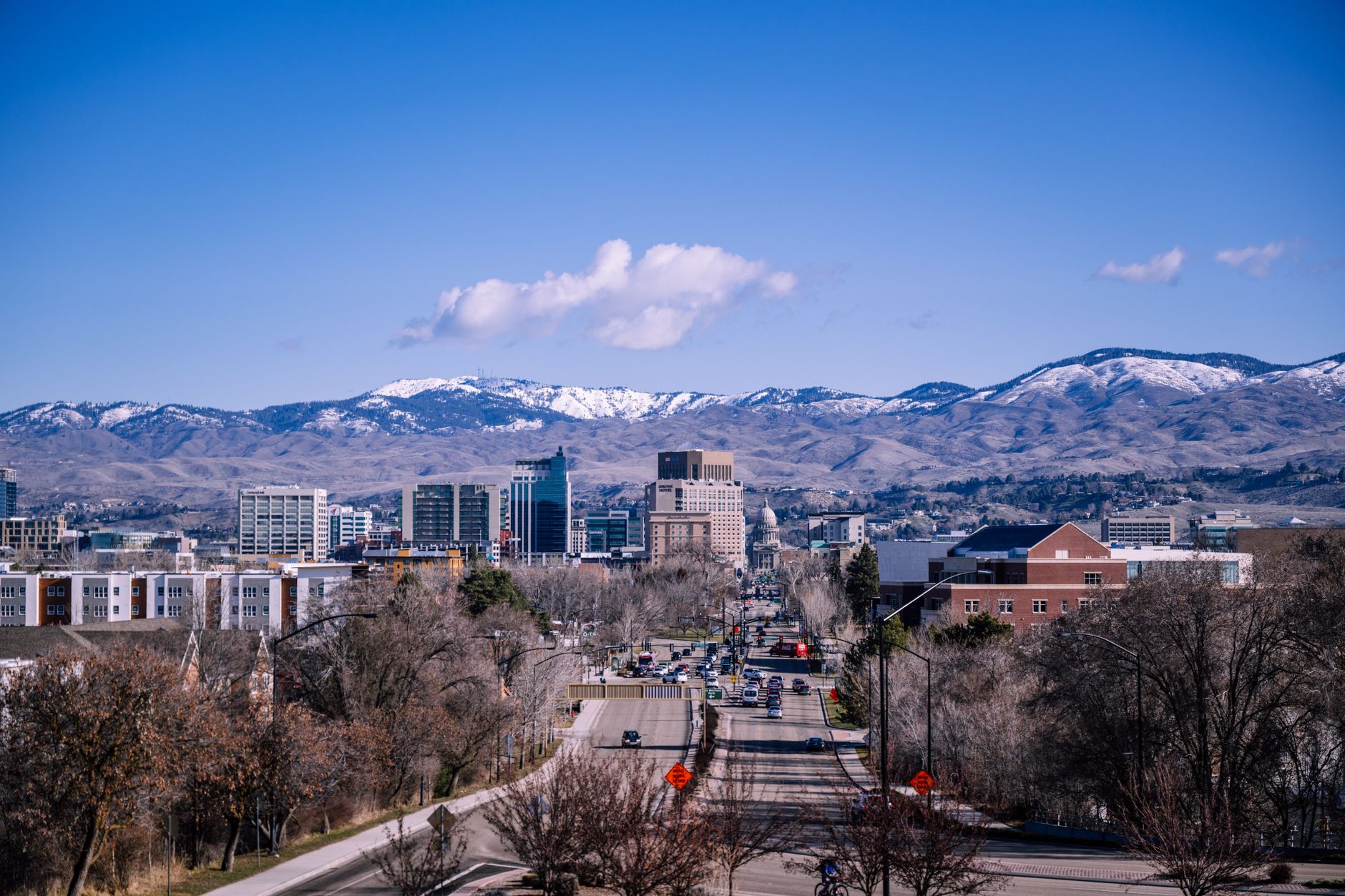
How does Boise’s geothermal system work?
Boise pumps naturally hot water from an underground aquifer, runs it through heat exchangers inside buildings to warm them, and either discharges or reinjects the cooled water. No electricity is generated. It is “direct use” heating, and the city of Boise operates one of the systems as a municipal utility, believed to be the oldest of its kind still running in the United States.
Where does the hot water actually come from?
The heat is geological, not artificial. Along the base of the foothills, a fault system allows groundwater to circulate deep enough to be warmed by the earth’s natural heat before rising back toward the surface through porous rock layers. Wells tap into this aquifer at depths ranging from a few hundred feet to well over 3,000 feet, drawing water that arrives at the wellhead well above room temperature — commonly cited in city and state materials as roughly 170–180°F, though exact figures vary by well and are best confirmed on the operator’s own site rather than repeated as fixed numbers here.
This is the same underlying resource that gave Warm Springs Avenue its name and its 19th-century identity as a resort district built around natural hot springs. The full history of that street and what runs beneath it is covered separately in what Warm Springs Avenue is, and what lies beneath it.
How does the water get from the ground into a building?
The mechanism is straightforward, even if the plumbing behind it is not:
- Production wells pull hot water from the aquifer.
- The water is piped, under pressure, through a distribution loop to connected buildings.
- Inside each building, a heat exchanger transfers warmth from the geothermal water into the building’s own heating system — radiators, air handlers, or floor systems — without the geothermal water itself circulating through the building’s pipes.
- The cooled geothermal water is then either injected back into the aquifer through separate wells or discharged, depending on the system and its permits.
Because the geothermal water never mixes with a building’s drinking water or its indoor air, the system functions as a heating source rather than anything a resident interacts with directly. The U.S. Department of Energy’s own description of direct-use geothermal systems covers this same basic loop — extraction, heat exchange, disposal — as the standard model nationally, and Boise is one of its most cited working examples.
What does the geothermal system actually heat?
Several separate systems operate across the city rather than one single network. Together, the publicly known connections include:
- The Idaho State Capitol, which has used geothermal heat since the early 1900s — the Capitol’s own materials and Idaho state sources describe this in more detail, covered separately in the article on the Idaho State Capitol’s geothermal heating.
- A cluster of downtown government and civic buildings connected to the city-operated system, including facilities near Boise City Hall Plaza and the block around the Ada County Courthouse.
- Boise State University buildings on its main campus, several of which draw heat from a university-connected geothermal loop.
- A set of private homes and businesses along and near Warm Springs Avenue, served by the separate, older Boise Warm Springs Water District, which predates the modern municipal system.
- A Veterans Administration medical facility in Boise, which operates its own geothermal connection.
These are not one continuous pipe network across the whole city — they are distinct systems, built at different times, drawing from the same aquifer along a similar fault corridor.
Is this available everywhere in Boise?
No. Geothermal heating in Boise is geographically limited to areas near the productive part of the aquifer, largely downtown and the older neighborhoods east of it along the foothill fault line. Most of the city — including the fast-growing subdivisions in West Boise and much of the Central Bench — heats conventionally, through natural gas or electricity, the same as any other American city of its size. Geothermal connection has never been standard citywide; it is a legacy infrastructure advantage tied to specific streets and institutions, not a feature of every address.
How old is Boise’s geothermal heating, and why does that matter?
The Warm Springs district’s use of natural hot water for heating dates to the late 1800s, when the springs were already known and developed for bathing before piped heat followed. The city-operated municipal system that heats downtown civic buildings developed later, expanding through the 20th century, and is frequently described by federal and state energy sources as the oldest continuously operating municipal geothermal district heating system in the country. That claim is made by the city and repeated in federal energy materials rather than independently verified here, and readers wanting the precise history should consult the city’s own public works materials on the system.
The practical result of that age is a working example, unusually rare for an American city, of a renewable heat source that predates the term “renewable energy” by decades. It has kept operating not as a demonstration project but as ordinary infrastructure, quietly heating government buildings through Boise’s cold, inversion-prone winters — a season described in more detail in what Boise’s winter inversion is, and why it matters.
Does Boise generate electricity from geothermal heat?
No. Boise’s system is direct-use only — heat is transferred and used as heat, not converted into power. Generating electricity from geothermal resources generally requires much higher temperatures and pressures than Boise’s aquifer produces at accessible depths. The distinction matters because geothermal power plants (common in parts of Nevada, California and elsewhere in the western U.S.) are a different technology entirely from what runs under Boise’s streets. Boise’s contribution is heat delivered directly to buildings, nothing more, nothing engineered beyond that.
What does this mean for someone living in or visiting Boise?
For a visitor, the geothermal system is mostly invisible — it shows up as a line in a museum placard or a mention on a walking tour of downtown, not as anything to see directly. For a resident, particularly one in the older core of the city, it can mean a building with unusually low heating costs and a landlord or HOA who can explain whether a specific address is on the geothermal loop. It is not something a new buyer or renter should assume; connection is specific to certain parcels and buildings, and confirming it means asking the property owner or checking with the relevant water district directly rather than assuming based on neighborhood alone.
The broader pattern — Boise using a geological quirk of its location to solve an ordinary civic problem — fits how the city tends to work more generally: practical, locally specific solutions rather than imported models. Readers interested in that pattern across other parts of city life, from its street grid to its transit system, can start with the overview at what it is actually like to live in Boise or the wider landmarks covered in the Landmarks & Sights archive.
Access Boise is an independent guide written from published, checkable sources. We have not visited the places described here and we do not publish personal recommendations or invented ‘local favourites’ — where something is singled out as notable, we say who says so. Opening times, fares, closures and prices change at short notice, so treat everything here as a starting point and confirm with the museum, operator or venue directly before building a day around it. We give no advice on visas, insurance, health or safety; use your own government’s official guidance for those.