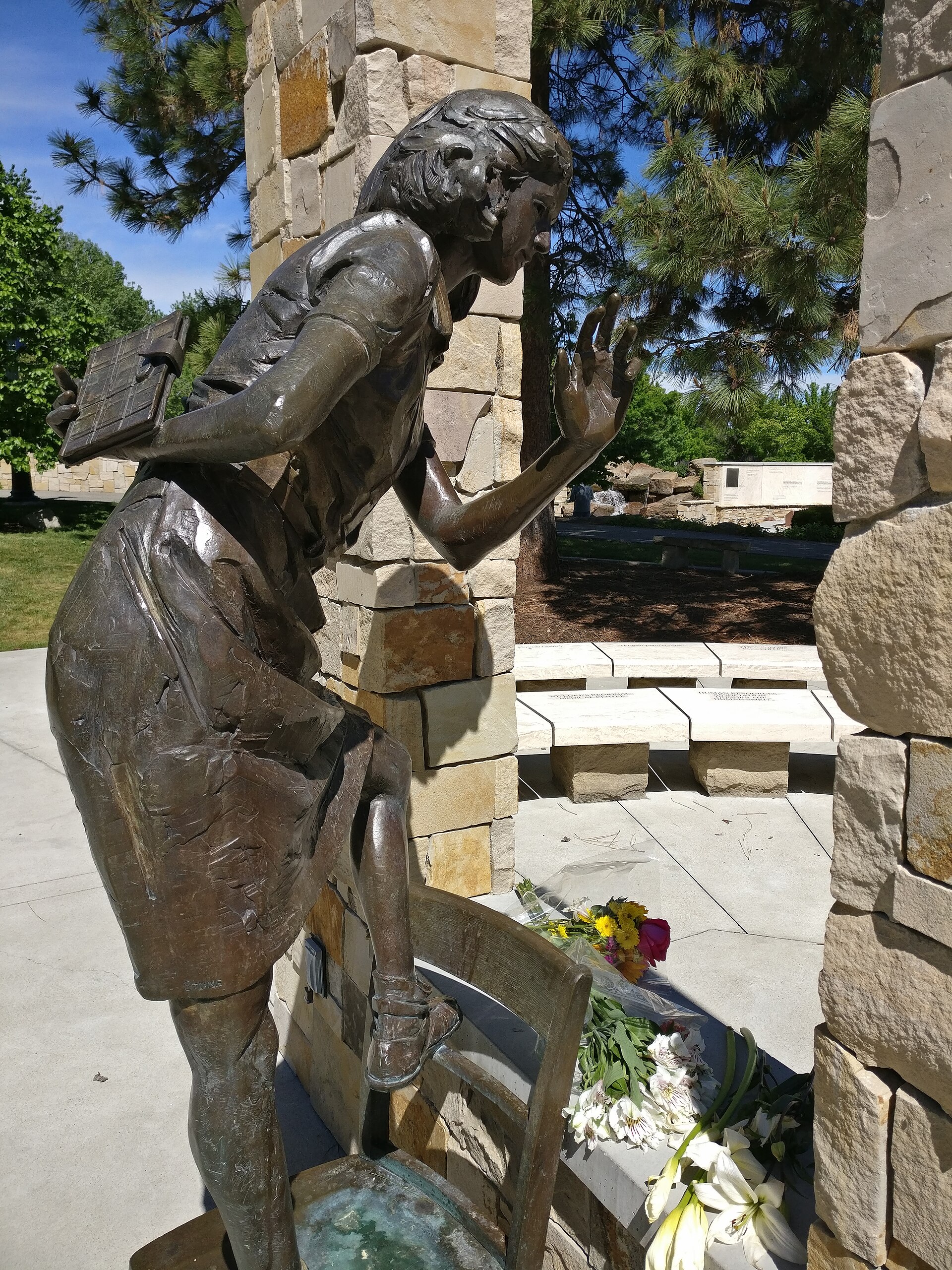
The Anne Frank Human Rights Memorial is a free, outdoor public memorial in downtown Boise dedicated to the Jewish diarist Anne Frank and, more broadly, to human rights history and education. It sits along the Boise River Greenbelt and combines a bronze statue of Frank with a long wall of quotations and interpretive panels on the Holocaust, civil rights, and Idaho’s own record on human rights.
Where is the memorial located?
The memorial occupies a stretch of open ground on the Boise River Greenbelt in the city’s downtown core, near the main branch of the Boise Public Library. It is built into the walking and cycling path system that runs along the river, so it functions as both a destination and a stop along a route people already use to get between downtown, Julia Davis Park, and the Boise State University campus.
Because it is outdoor, unticketed, and integrated into a public path, there is no gate, admission booth, or fixed visiting window in the way a museum has one. It reads more like a piece of civic infrastructure — a memorial park — than an attraction with hours to check. Readers exploring the surrounding paths and green space more generally can find context in Access Boise’s Parks & Foothills coverage.
Who built the memorial, and why Anne Frank?
The memorial was created by the Wassmuth Center for Human Rights, a Boise-based nonprofit organized around human rights education. According to the Wassmuth Center’s own site, the memorial opened in 2002 and was conceived as a way to root abstract human rights principles in a specific, documented life — Anne Frank’s diary, written while her family hid from Nazi occupation in Amsterdam, is one of the most widely read primary documents of the Holocaust.
Frank has no personal connection to Idaho. The choice of her as the memorial’s central figure is deliberate and stated by the organization itself: her diary is used internationally as an entry point into Holocaust history for readers, including young readers, who might otherwise encounter it only as abstract statistics. The Anne Frank House in Amsterdam, which preserves the actual hiding place described in the diary, is the primary international authority on her life and the diary’s history for readers who want the fuller account.
What does the memorial contain?
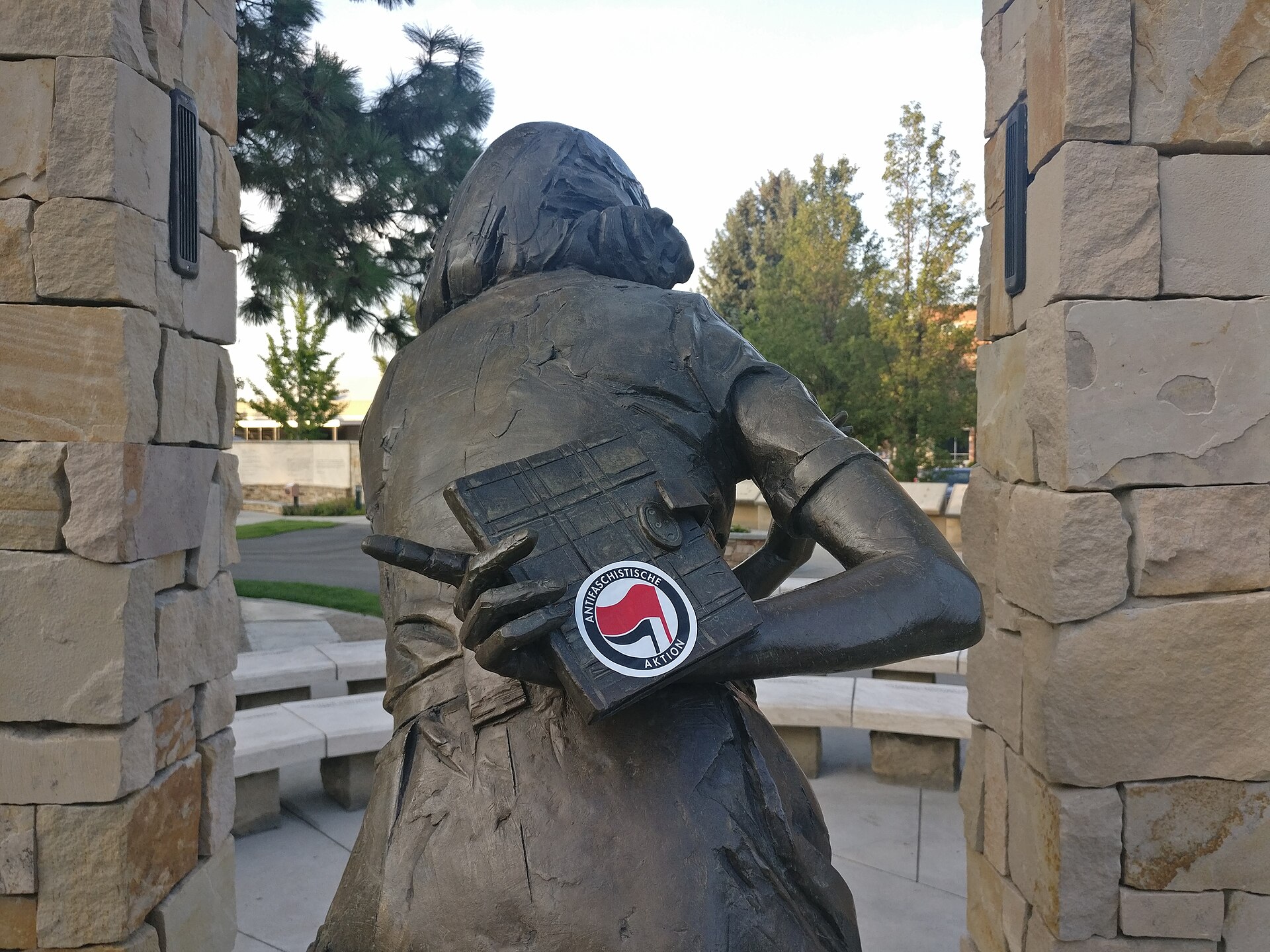
The memorial’s central element is a bronze statue of Anne Frank. Around and beyond it runs what the Wassmuth Center refers to as the Wall of Quotes — a long series of engraved panels carrying statements on human rights and freedom of conscience from a wide range of historical figures, spanning well beyond the Holocaust itself.
- A bronze statue of Anne Frank as the memorial’s central figure
- A curved Wall of Quotes with statements from historical and human rights figures
- Interpretive panels tracing the Holocaust and the history of the Frank family
- Additional panels addressing other human rights struggles, including the civil rights movement and Japanese American internment
The panels are arranged so that a visitor moves through a rough chronology — from the specific history of the Frank family and the Holocaust outward to other twentieth-century human rights struggles. It is designed to be walked and read, not viewed from a single vantage point, which is part of why it sits on a path rather than in a plaza.

Who was Bill Wassmuth, and what is the Wassmuth Center?
The organization behind the memorial is named for Bill Wassmuth, a Catholic priest based in Coeur d’Alene, in North Idaho, who became a prominent public opponent of the Aryan Nations, a white supremacist organization headquartered near Hayden Lake through much of the late twentieth century. Wassmuth’s home was bombed in 1986 in connection with that opposition, and he went on to found and lead organizations focused on countering hate groups and promoting human rights education in Idaho.
The Wassmuth Center for Human Rights, which built and maintains the Anne Frank memorial, carries his name and continues that mission through public programming, school curricula, and the memorial itself. This local history is part of why the memorial’s panels extend into Idaho-specific material rather than staying confined to European history — the state has its own documented record with organized hate groups that the Center treats as directly relevant.
Readers interested in how Idaho institutions document the state’s broader civil rights and social history can also see Access Boise’s coverage of the Idaho Black History Museum, which similarly treats civil rights as local rather than only national history.
Is the memorial free, and when can it be visited?
Yes. As an outdoor public memorial integrated into the Greenbelt path system, there is no admission fee. Because opening times, seasonal maintenance closures, and any programmed events are set and changed by the Wassmuth Center rather than fixed permanently, readers should confirm current details on the organization’s own site before planning a visit around a specific date.
The memorial’s outdoor nature also means its condition and appearance shift with the season — Boise’s river corridor freezes and floods in different years, and landscaping around the site is maintained on the city’s own schedule. This is consistent with how the rest of the Greenbelt behaves; it is a working piece of city infrastructure, not a controlled museum environment.
How does the memorial connect to Idaho’s own history?
The memorial explicitly does not confine itself to Holocaust history. According to the Wassmuth Center, its panels also address Japanese American internment during the Second World War — a history with a direct Idaho connection, since the Minidoka War Relocation Center, one of ten camps where Japanese Americans were incarcerated by the federal government, operated in south-central Idaho and is today preserved as a National Park Service site.
That layering — a European history used as an entry point, extended outward into American and Idaho-specific history — is the memorial’s organizing idea. It treats human rights abuses as a pattern that recurs in different places rather than a single closed historical event, and it uses Idaho’s own record, including North Idaho’s history with organized hate groups, as part of that pattern rather than an exception to it.
What else is nearby?
The memorial’s location on the Greenbelt puts it within walking distance of several other Boise institutions covered elsewhere on this site. The Idaho State Museum’s exhibits on state history give broader context for the material the memorial’s panels touch on; readers can find what that collection covers in Access Boise’s guide to the Idaho State Museum. Boise Art Museum, also nearby, is the city’s principal venue for public art in a gallery setting, described in the site’s guide to the Boise Art Museum collection.
More broadly, the memorial sits within a cluster of downtown museums and landmarks that make up a significant share of what a first-time visitor or a longtime resident is likely to want an accurate account of. Access Boise’s Museums & Galleries hub and its Landmarks & Sights hub both index that wider set of institutions for readers planning a longer walk through downtown Boise.
For the memorial’s own current details — hours, any programming, and its full account of the Wall of Quotes — the Wassmuth Center for Human Rights’ own site remains the primary source, and readers weighing a visit should check it directly rather than rely on secondhand listings.
Access Boise is an independent guide written from published, checkable sources. We have not visited the places described here and we do not publish personal recommendations or invented ‘local favourites’ — where something is singled out as notable, we say who says so. Opening times, fares, closures and prices change at short notice, so treat everything here as a starting point and confirm with the museum, operator or venue directly before building a day around it. We give no advice on visas, insurance, health or safety; use your own government’s official guidance for those.
Featured image: Photo by Kencf0618, source, CC BY-SA 4.0
