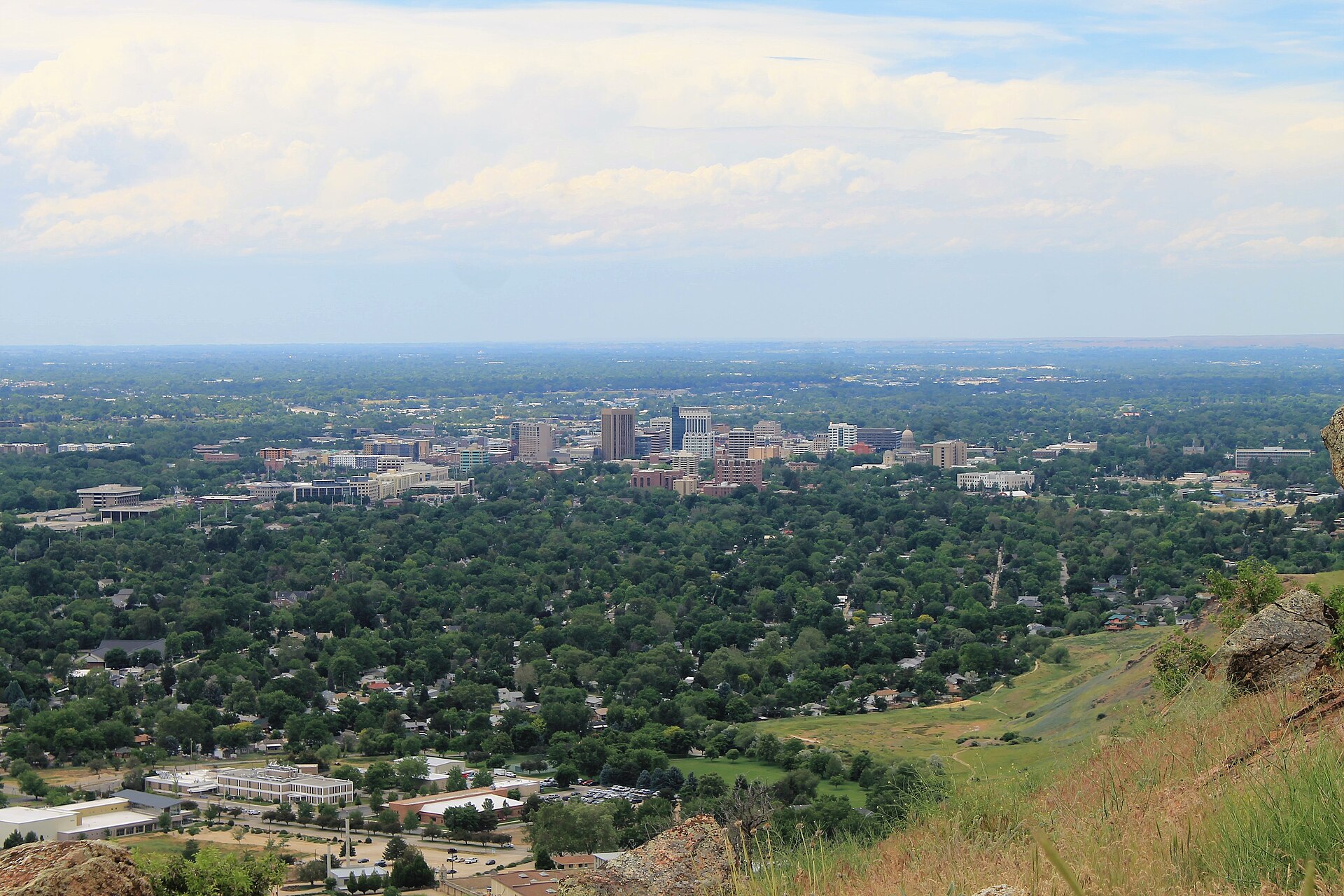
People usually mean three linked things at once: the population grew fast in a short window, housing became far more expensive relative to local wages, and downtown filled in with taller buildings and more traffic. These are documented shifts, tracked by the U.S. Census Bureau, the Idaho Department of Labor, and the city of Boise itself — not just an impression.
How much has Boise actually grown?
Ada County, which contains Boise, was among the fastest-growing counties in the country for several years running in Census Bureau population estimates released through the 2010s and into the early 2020s. The city of Boise’s own population passed 100,000 decades ago; the growth people are describing now is regional — Ada and Canyon counties together, not just the city limits.
That regional framing matters. Much of the growth landed in Meridian, Eagle, Kuna and Nampa as much as in Boise proper, which is part of why the metro area feels different even where the city itself changed less. The neighbourhoods people describe as unrecognisable are often specific ones — the North End, Downtown-adjacent blocks, the Bench — rather than the whole city moving in lockstep.
What does the housing market show?
This is the change most people mean first. Median home prices in Ada County rose sharply from roughly 2016 through 2022, a run documented by Boise Regional Realtors’ own market data and referenced repeatedly in Idaho Department of Labor housing-affordability analyses. Boise went, over a few years, from a market comparable to other mid-size Western cities to one of the least affordable relative to local median income.
The mechanics of that shift — what drove it, where prices sit now, and how the market has cooled or hasn’t — are covered in detail on this site’s own explanation of what happened to Boise’s housing market. The short version: demand from buyers moving in with equity from higher-priced markets outpaced local construction and local wages for several years, and the gap between Boise home prices and Boise incomes widened faster than in most comparable cities.
Why did so many people move here?
Attribution matters here because the explanations are often assumed rather than sourced. Idaho Department of Labor migration data and Census Bureau American Community Survey figures both show sustained net in-migration to Idaho through the 2010s and early 2020s, with a disproportionate share landing in the Boise metro. Commonly cited reasons — remote work flexibility, lower costs relative to California and parts of the Pacific Northwest, outdoor access — appear in state labor market reporting as plausible drivers, though the department itself is careful to describe correlation rather than a single proven cause.
What is measurable is where people moved from: state migration data has consistently shown California as the largest single source of new Idaho residents in recent years, followed by other Western states. This site’s own look at what it’s actually like to move to Boise from out of state goes into what that transition involves in practice.
.jpg)
How has downtown itself changed physically?
Downtown Boise added office towers, residential high-rises and mixed-use blocks through the 2010s and 2020s that didn’t exist before — projects tracked in the city of Boise’s own planning and permitting records rather than in any single news account. The skyline changed because the zoning and market conditions allowed taller buildings where the city had previously been low-rise almost throughout.
Traffic and street design changed alongside it. State Street’s ongoing corridor project, aimed at handling growth along one of the city’s oldest arterial routes, is one of the more visible pieces of this; the city’s own reasoning for the rebuild is explained in this site’s piece on why State Street was rebuilt. Similarly, the Connector — Interstate 184 — remains a short freeway spur that stops abruptly at downtown, a design decision from decades ago now under more pressure with higher traffic volumes; that’s covered separately in this site’s explanation of why the Connector ends where it does.
Has the job market changed along with the population?
Yes, and this is the part often left out of the “Boise has changed” conversation in favour of housing alone. Idaho Department of Labor data shows the Boise metro area diversifying beyond its historic base in agriculture, food processing and government employment, with growth in technology, healthcare and professional services sectors through the 2010s. Micron Technology and Boise-based companies in tech and outdoor-industry manufacturing expanded hiring during this period, according to the department’s own industry breakdowns.
Boise State University’s enrollment and physical footprint also grew substantially over the same period, a shift this site covers in its explanation of Boise State University’s place in the city. A larger student and research population is part of why some neighbourhoods near campus changed character. The broader question of how local employment actually functions now — who’s hiring, what pays what — is addressed in this site’s piece on how Boise’s job market actually works.
What do longtime residents say has changed about daily life?
This is the hardest category to source cleanly, because it’s opinion rather than data — but it recurs consistently enough in city planning documents, public comment records and Idaho Department of Labor cost-of-living reports to be worth naming as a pattern rather than a single voice. Three things come up repeatedly:
- Commute times lengthening, tied to regional sprawl outward into Meridian, Eagle and Nampa rather than density within Boise itself.
- A sense that neighbourhoods once affordable to buy into — parts of the Bench, the North End — priced out buyers who grew up there, a dynamic documented in county assessor and Realtor association data rather than anecdote alone.
- More visible construction, more cranes, and longer waits for services that scaled more slowly than the population — a concern the city has addressed directly in its own utilities and infrastructure planning documents.
How day-to-day costs actually compare to the rest of the state, rather than to memory, is covered in this site’s comparison of Boise’s cost of living against the rest of Idaho. It’s a useful corrective: Boise has gotten more expensive in absolute terms, but it remains less expensive than many of the coastal metros people moved from — which is part of why in-migration didn’t reverse as prices climbed.
Is the change slowing down?
Population growth rates in Ada County moderated somewhat after the sharpest years of the pandemic-era surge, according to more recent Census Bureau estimates, though the county has continued to add residents rather than lose them. Housing price growth also cooled from its steepest run, without falling back to pre-surge levels — a pattern this site’s housing market piece tracks in more detail.
What hasn’t reversed is the physical and institutional change already built: the taller downtown, the university’s larger footprint, the wider job base. Those are durable. Whether the pace of arrival continues at the same rate is a separate question from whether Boise has already changed — by most measurable standards, it has, and the changes already visible aren’t the kind that get undone.
For a broader look at how the city functions day to day now — services, transit, neighbourhoods, schools — this site’s Living in Boise hub and its Living in Boise archive cover the practical detail behind these shifts in more depth than any single explanation of “what changed” can hold.
Access Boise is an independent guide written from published, checkable sources. We have not visited the places described here and we do not publish personal recommendations or invented ‘local favourites’ — where something is singled out as notable, we say who says so. Opening times, fares, closures and prices change at short notice, so treat everything here as a starting point and confirm with the museum, operator or venue directly before building a day around it. We give no advice on visas, insurance, health or safety; use your own government’s official guidance for those.
Featured image: Photo by Rickmouser45, source, CC BY-SA 4.0

Related reading
How Does Refuse and Recycling Work in Boise? A Straight Answer.