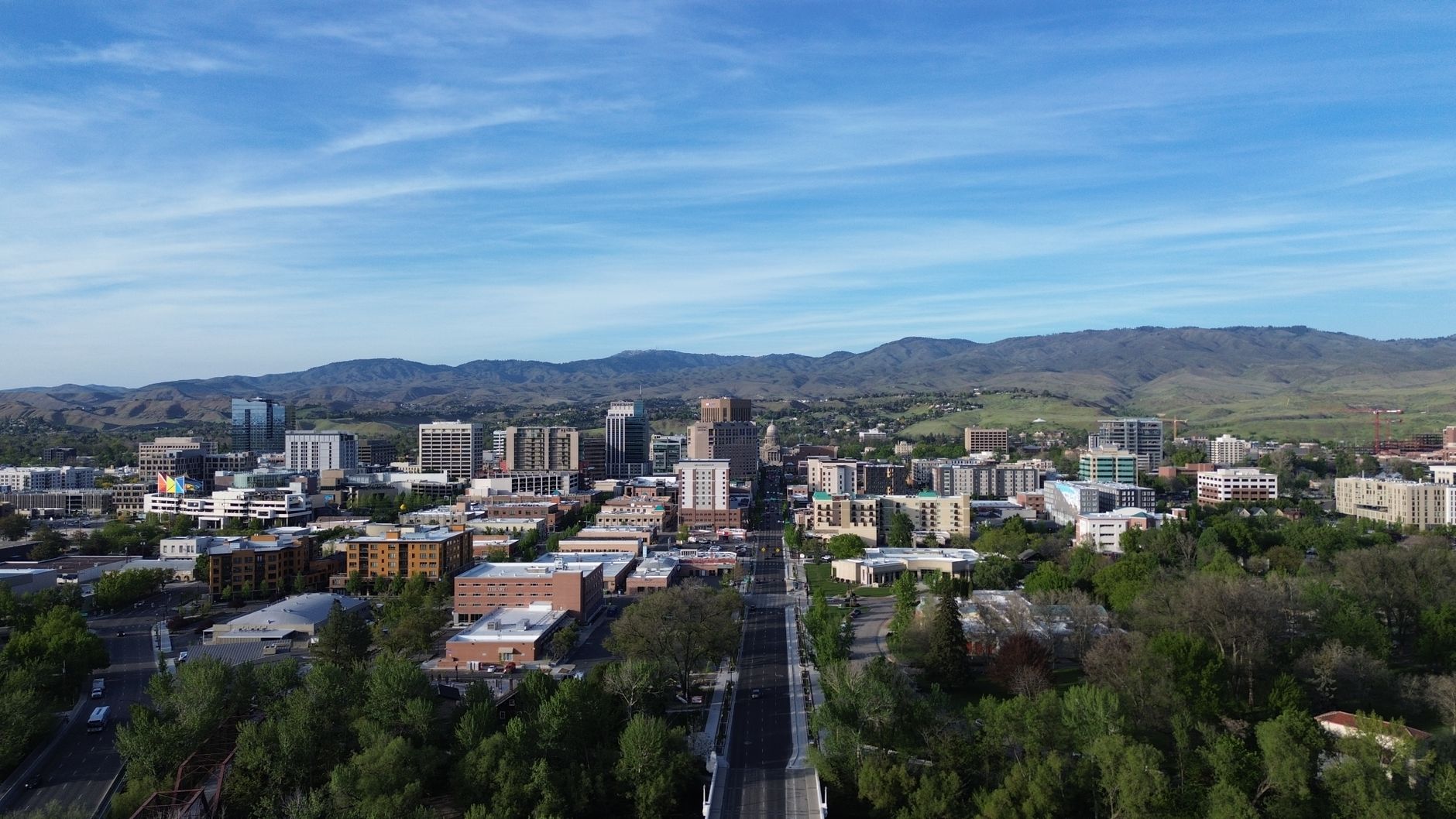
Vista is a residential and commercial district on the Boise Bench, south of the Boise River and Downtown Boise, built around Vista Avenue as it runs from the edge of the city centre down to Boise Airport. It is one of the neighbourhoods the city of Boise formally recognises through its neighbourhood association programme, with its own defined boundaries and adopted neighbourhood plan.
Where does Vista actually sit in Boise?
Vista occupies part of the Boise Bench, the elevated terrace of land south of the river that rises abruptly above the downtown floodplain. The district sits roughly between Capitol Boulevard to the west, Federal Way and the rail corridor to the east, and stretches from the upper edge of the Bench near the Boise Depot south toward Boise Airport and the Interstate 84 corridor.
Readers unfamiliar with the term “the Bench” — the geological feature that shapes so much of how south Boise is laid out — can find a fuller explanation in what the Boise Bench is and why it’s called that. Vista is one of several named neighbourhoods that sit on that terrace, alongside Central Bench and Depot Bench to its west and north.
What does Vista Avenue connect?
Vista Avenue is the spine of the neighbourhood and one of Boise’s principal north–south arterials. It climbs the face of the Bench from near Capitol Boulevard and the Boise Depot area, crosses Interstate 84, and continues south to Boise Airport, making it the most direct surface route between the city centre and the terminal for anyone not using the freeway.
That function — connector between downtown, the interstate, and the airport — is central to understanding why the corridor developed the way it did: as a mixed commercial strip serving through-traffic and a growing residential population on either side of it, rather than as a self-contained retail centre in the way Hyde Park or the Basque Block are.
How did the neighbourhood take shape?
Housing in Vista is largely mid-20th century, reflecting the district’s growth in the decades after the Second World War, when Boise expanded south onto the Bench and southward toward what was then Gowen Field, the Army Air Forces base that shares its runways with today’s Boise Airport. The result is a housing stock dominated by modest single-family homes and low-rise apartment buildings from that era, interspersed with newer infill.
The city of Boise’s own neighbourhood plan for Vista, adopted as part of its comprehensive planning process, documents these boundaries and land-use patterns in more detail than is useful to summarise here, and it is the primary public record for anyone researching the district’s zoning and development history rather than a secondary account.

Why is Vista often described as one of Boise’s most diverse neighbourhoods?
Vista is frequently cited, including in reporting on Boise’s long-running role as a refugee resettlement city, as home to a notably diverse population relative to the city as a whole. Idaho has resettled refugees for decades under federal programmes, and the Idaho Office for Refugees — housed at Boise State University — coordinates much of that work statewide. Vista’s affordable rental housing and its position along a major transit corridor are commonly cited reasons resettled families and other newer arrivals have concentrated in the area.
This is a demographic characteristic worth naming honestly rather than glossing as atmosphere: it shapes the commercial mix along Vista Avenue, the languages spoken in the neighbourhood’s schools, and how the district is discussed in city planning and social-service contexts. It is not something this site can quantify precisely, and current figures are best sought from the U.S. Census Bureau’s American Community Survey data for the relevant tract, or from the city of Boise’s own demographic profiles.
What landmarks sit in or near Vista?
The Boise Depot, the Union Pacific station completed in 1925, sits at the top of the Bench near the northern edge of the district, overlooking downtown and the river below. Its history and architecture are covered separately in what the Boise Depot is and why it looks the way it does, and the grounds around it — including Platt Gardens — are addressed in a guide to the Boise Train Depot and Platt Gardens.
South of the residential core, Vista Avenue terminates near Boise Airport, and the corridor also runs close to the Interstate 84 interchange that most visitors use to reach downtown from the airport. Vista does not contain a major museum, monument, or listed historic district of its own; its significance is functional and residential rather than monumental, which is precisely why it rarely appears on visitor itineraries built around Boise’s landmarks and sights.
Is there anything for a visitor to do in Vista?
Vista is not built as a destination in the way the North End or the Basque Block are, and this site will not describe it as one. Its interest for an outsider is largely explanatory: it demonstrates how Boise’s Bench neighbourhoods actually function as working residential districts rather than as curated tourist zones, and how a single arterial road can define a place more than any single building does.
A visitor with an interest in the airport corridor, the city’s post-war growth, or its history as a resettlement community will find Vista instructive to drive or cycle through on the way south, but the practical planning for a Boise visit — transit, foothills access, and food and itinerary basics — is better handled at the site’s own practical guide to getting around Boise.
How does Vista fit into daily life for residents?
For people who live in or near Vista, the neighbourhood functions mainly as an affordable, well-connected residential area with direct road access to downtown, the interstate, and the airport — a combination that matters more to daily commuting than to any single amenity. Its neighbourhood association, like others recognised by the city, gives residents a formal channel into Boise’s planning process, including notice of zoning changes and infrastructure projects that affect the Vista Avenue corridor specifically.
Anyone assessing Vista as a place to live, rather than a place to pass through, should treat the city’s own neighbourhood association pages and adopted neighbourhood plan as the primary source, rather than general description here, since boundaries, zoning, and planning priorities are the kind of detail that changes with city council action and is published directly by the city of Boise.
How does Vista relate to Boise’s other neighbourhoods?
Vista is best understood as one of several Bench-area districts that together form the residential ring south of the river, distinct from the more heavily documented historic districts closer to downtown. Readers wanting the fuller map of how these areas relate to one another — Vista alongside the North End, the East End, Hyde Park, and the Bench itself — can use the site’s own neighbourhoods archive or the broader guide to what it’s actually like to live in Boise as a starting point, and the city-wide guide to Boise’s museums, landmarks and neighbourhoods for context on how each district fits into the whole.
Access Boise is an independent guide written from published, checkable sources. We have not visited the places described here and we do not publish personal recommendations or invented ‘local favourites’ — where something is singled out as notable, we say who says so. Opening times, fares, closures and prices change at short notice, so treat everything here as a starting point and confirm with the museum, operator or venue directly before building a day around it. We give no advice on visas, insurance, health or safety; use your own government’s official guidance for those.