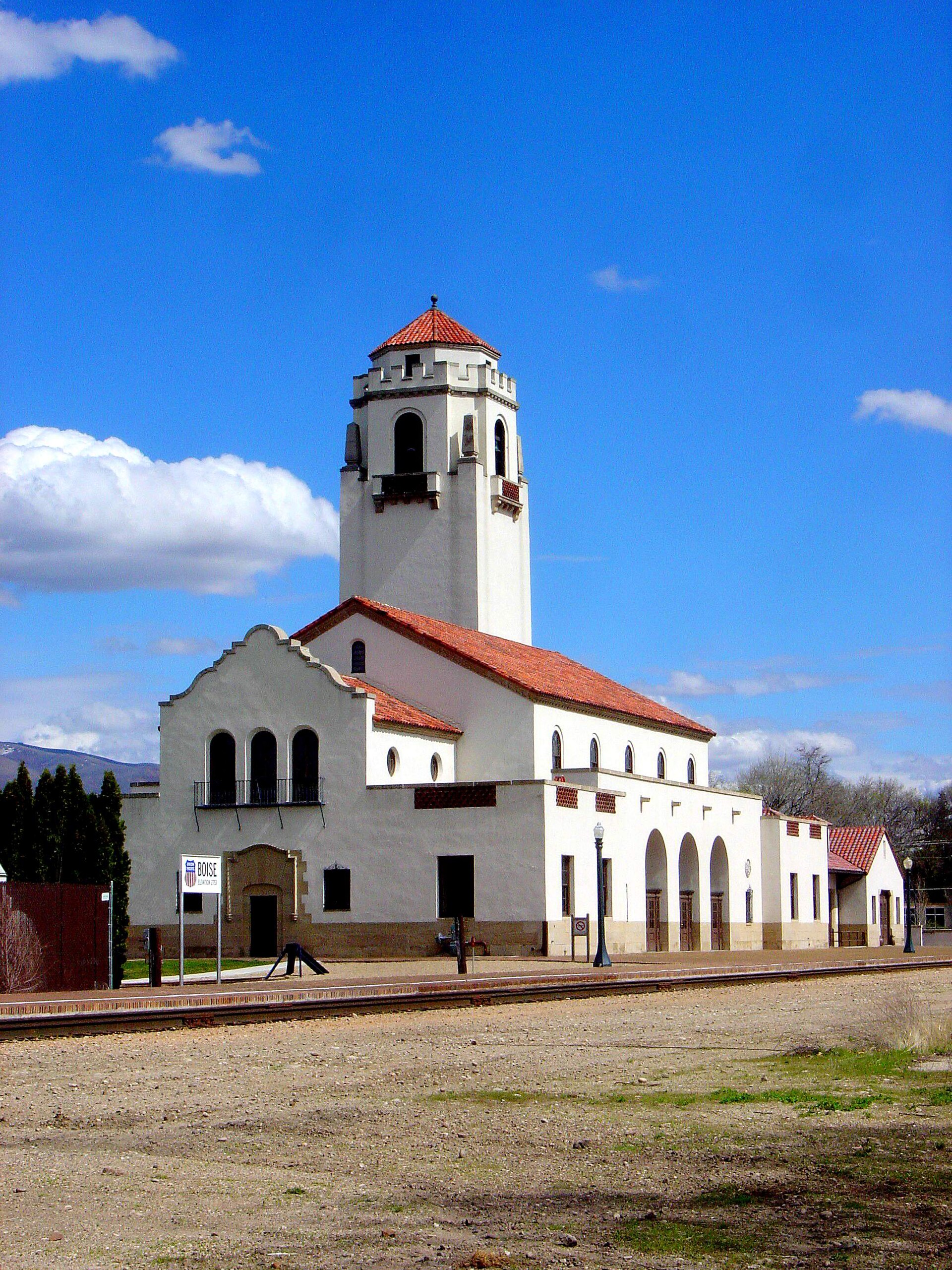
The Boise Depot is a former passenger railway station built in 1925 by the Union Pacific Railroad, standing on a bluff at the south end of Capitol Boulevard. Its Mission Revival design — a tiled bell tower, arched arcades, stucco walls — copies the look of Spanish mission churches in California, a style Union Pacific used deliberately to market rail travel to the American West as scenic and historic.
What is the Boise Depot, exactly?
It is a railway station the Union Pacific Railroad built to serve Boise, replacing an older, smaller depot that had stood closer to the center of the city. Construction finished in 1925, and the building operated as a working passenger station for most of the twentieth century. It no longer functions as a train station; the city of Boise now owns the building and uses it as an event and civic venue, with the surrounding grounds kept as public park space.
Why does it look like a Spanish mission?
Because Union Pacific chose Mission Revival architecture on purpose, not by local accident. The style — low tile roofs, deep-set arches, a freestanding bell tower — was borrowed from Spanish colonial mission churches built in California in the 18th century, and by the early 1900s American railroads had adopted it widely for stations across the West as a way of selling rail travel as romantic and rooted in regional history.
The Idaho State Historical Society’s records on the building describe the Boise Depot’s tower as directly modeled on the bell towers of California mission churches, a detail that made the station distinctive against Boise’s otherwise brick-and-stone downtown. The building has no functional connection to any mission; the style was imported wholesale as an architectural statement, the same way other Union Pacific stations across Idaho, Utah and California used matching Mission Revival details to brand the railroad’s Western routes as a coherent, recognizable product.
Why does it sit on a hill, away from downtown?
The depot’s location was the result of a long dispute between the city of Boise and Union Pacific over where the railroad’s tracks and station would go. The railroad wanted a route and site that suited its own operations; the city wanted the depot close to its commercial core. The compromise placed the depot on a bench above the Boise River, south of downtown, with the building oriented to face north.
That orientation was not incidental. Capitol Boulevard was built as a straight, formal approach connecting the depot directly to the Idaho State Capitol several blocks away, so that a passenger stepping off a train had a direct sightline up the boulevard to the capitol dome. The alignment was a deliberate piece of city planning completed alongside the depot itself, meant to give arriving visitors an immediate, legible image of the city’s civic center.
Who designed the building?
Idaho State Historical Society records attribute the design to the New York architectural firm of Carrère and Hastings, a firm better known nationally for the New York Public Library, which also produced designs for several Union Pacific stations built in the Mission Revival idiom in the early 20th century. The Boise Depot was one of a family of related stations the railroad commissioned in a similar style across its Western network, rather than a one-off local design.

Does the Boise Depot still run trains?
No. Regular passenger rail service through Boise ended in the 1990s, when Amtrak discontinued the route that had stopped at the depot, and no scheduled passenger train has served the building since. The tracks nearby remain in use for freight, but the depot itself has not functioned as an active station for decades.
Because it no longer runs trains, the building’s current use is entirely civic. The city of Boise manages the Boise Depot as a rentable venue for weddings, public events and community gatherings, and the grounds are open as public park land, distinct from the building’s original transportation function.
What is there to see at the depot today?
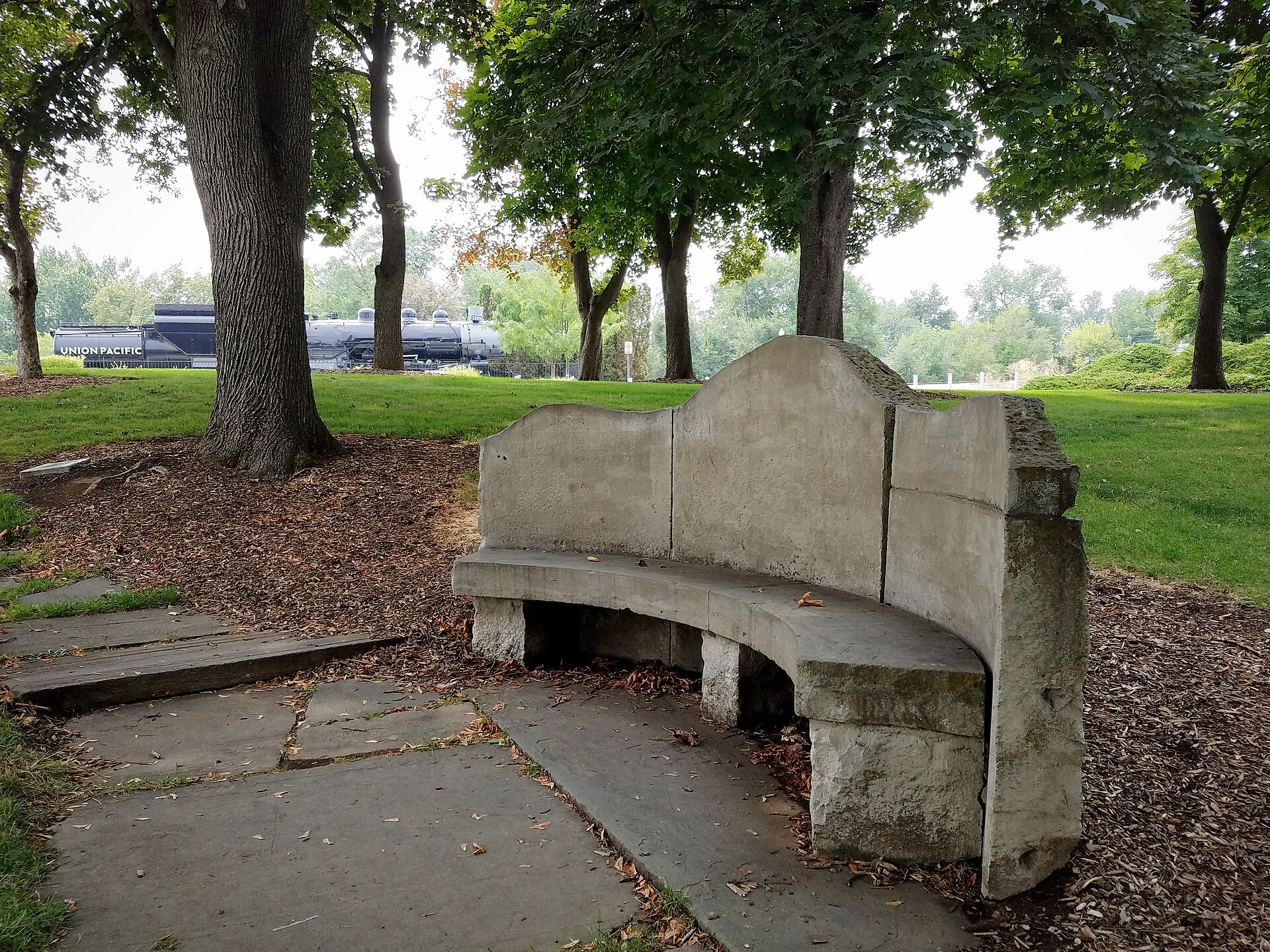
The building itself — its arcaded facade, tower, and waiting-room interior — is the primary point of interest, along with the surrounding gardens and park grounds. The adjacent Platt Gardens area is landscaped public space around the depot, and the grounds have historically included a static steam locomotive on public display near the depot, part of the site’s role as a preserved piece of the city’s rail history rather than a working transit hub.
Because the depot functions as an event venue, public access to the interior can vary depending on bookings; the city of Boise’s own site is the source to check for current access and any scheduled public hours before visiting.
Is the Boise Depot a protected historic building?
Yes. The Boise Depot is listed on the National Register of Historic Places, the federal government’s official list of historic sites maintained by the National Park Service. That listing recognizes the building’s architectural and historical significance but does not by itself guarantee public access; it is a designation about preservation status, not a visitor program.
The National Register listing places the depot in the same category of formally recognized historic sites as other Boise landmarks covered elsewhere on this site, including the Old Idaho Penitentiary, a former state prison also on the National Register with its own separate visiting arrangements.
How does the depot fit into Boise’s broader museum and landmark landscape?
The Boise Depot is a building to look at and understand rather than a collecting institution, which puts it in a different category from the city’s museums even though it sits near several of them in the city’s cluster of civic institutions. For collections of Idaho history and material culture, the Idaho State Museum holds the state-level archive that the depot itself does not attempt to be.
Readers assembling a fuller picture of Boise’s historic architecture and civic sites can also look at the Basque Museum and Cultural Center, housed in one of downtown’s oldest surviving buildings, and the Boise Art Museum, a civic institution built specifically as a gallery rather than repurposed from another use. Together these represent the range of what “historic Boise” actually means in practice: a working prison, a converted boarding house, a purpose-built gallery, and a decommissioned railway station, each preserved for a different reason.
The broader set of Boise’s protected buildings and monuments is tracked on this site’s Landmarks & Sights hub, while the city’s collecting institutions — museums with holdings rather than buildings alone — are gathered under Museums & Galleries. Both categories help place the depot in context: it is a landmark first, and only incidentally a place with things inside it.
What should a visitor actually expect to find there?
A visitor should expect an exterior worth seeing on its own terms — the tower, the arcades, the axial view down Capitol Boulevard — and an interior whose accessibility depends on whether the building is booked for an event on a given day. It is not a staffed museum with fixed daily hours in the way the Discovery Center of Idaho or the Idaho State Museum are, and treating it as a drop-in attraction without checking current access risks a wasted trip.
Residents get more use out of the site as park space than as a building to enter: the grounds function as ordinary public green space year-round, independent of whatever event may be using the depot itself on a particular weekend. Anyone planning around a specific date — a wedding, a public open house, a seasonal event — should confirm current details directly through the city of Boise’s own management of the site rather than relying on secondhand listings, since venue schedules and public-access windows change independently of the building’s fixed historic status.
Access Boise is an independent guide written from published, checkable sources. We have not visited the places described here and we do not publish personal recommendations or invented ‘local favourites’ — where something is singled out as notable, we say who says so. Opening times, fares, closures and prices change at short notice, so treat everything here as a starting point and confirm with the museum, operator or venue directly before building a day around it. We give no advice on visas, insurance, health or safety; use your own government’s official guidance for those.
Featured image: Photo by Tamanoeconomico, source, CC BY-SA 4.0
