
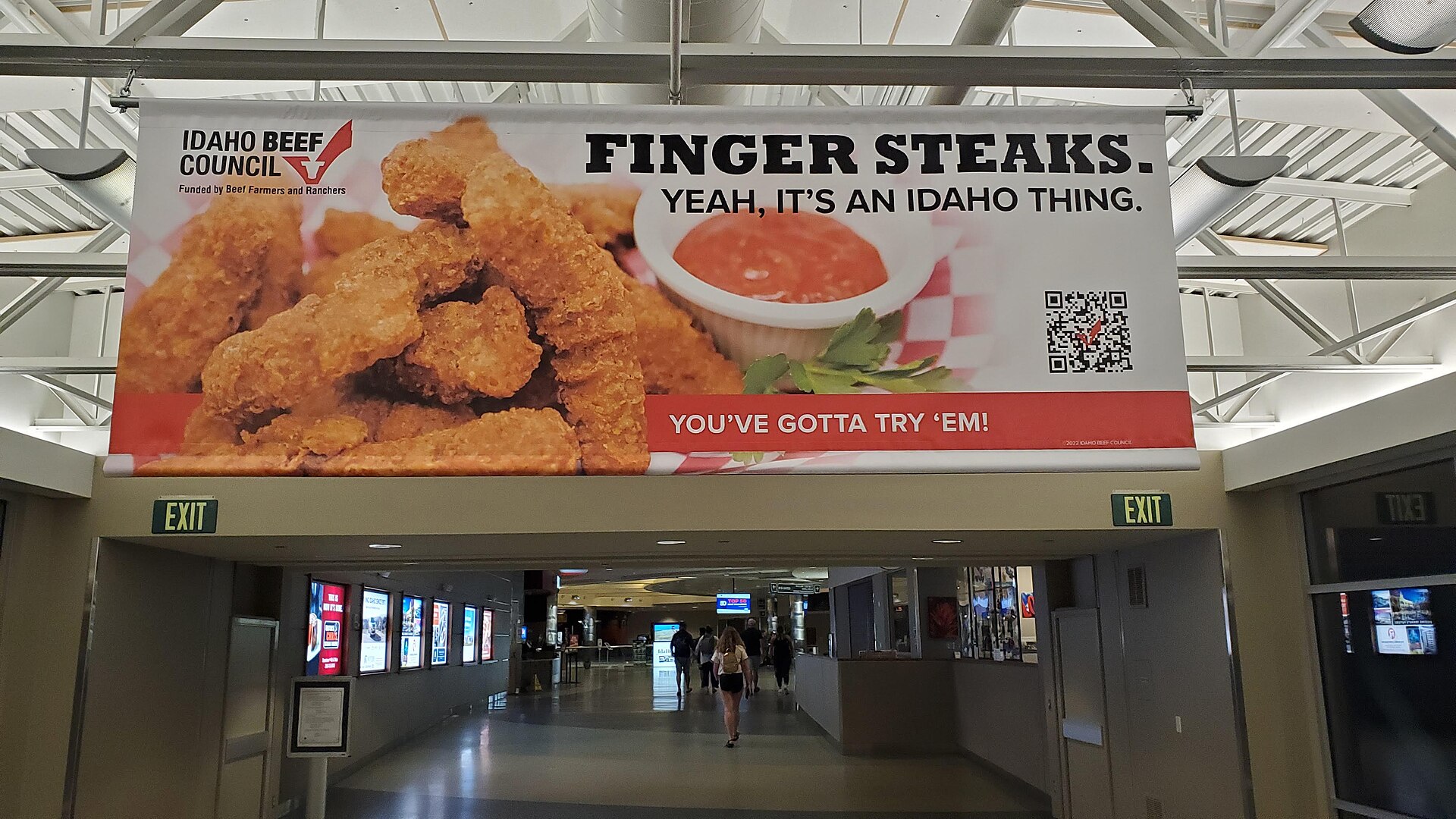
A finger steak is a strip of beef, cut thin, battered, and deep-fried, then served with a dipping sauce — usually cocktail sauce or Idaho’s own fry sauce. It is not the same as a chicken finger and not the same as chicken-fried steak on a plate with gravy. It is a bar-and-diner food, eaten by hand, and it is closely tied to Boise’s mid-20th-century restaurant history.
What exactly is a finger steak?
A finger steak is a strip of beef — typically cut from sirloin, round, or trimmed steak — dipped in batter and deep-fried until the outside is crisp and the inside stays tender. It is served as an order of several strips, usually with a small cup of sauce for dipping, and it appears on menus as an appetizer, a bar snack, or a full plate with fries.
The dish is distinct from two things it is often confused with:
- Chicken fingers, which use poultry rather than beef and are a national fast-food staple with no particular regional claim.
- Chicken-fried steak, a Southern and Southwestern dish that batters and pan-fries a single flattened cutlet, then covers it in white gravy — a different cut, a different cooking method, and a different plate.
Finger steaks are cut into strips before frying, deep-fried rather than pan-fried, and served dry with a dip rather than smothered in gravy. That combination — strip cut, deep fry, dipping sauce — is what makes the dish its own category rather than a variant of something else.
Where did finger steaks come from?
The dish is widely credited to Boise, and the story repeated most often in Idaho newspapers and food writing places its invention in a Boise lounge in the 1950s. In that version, a restaurant owner facing a surplus of steak trimmings — the strips left over after cutting filets and other cuts to order — battered and deep-fried the scraps rather than waste them, and the result caught on with customers.
Access Boise treats this as attributed local history rather than settled fact. The story recurs across secondary sources and oral accounts collected by Idaho food writers, and it is consistent in its broad shape — a Boise establishment, a 1950s date, a practical solution to unused steak trim — but it is not backed by a single primary document that this site can independently verify. Readers who want to trace the claim to its original reporting should look to the Idaho Statesman’s own archives and to any Idaho food-history material published by the Idaho State Historical Society, both of which are better positioned to confirm or correct the specific restaurant and date involved than a general guide can be.
What is not in dispute is the dish’s association with Boise specifically, rather than with Idaho as a whole or with the broader Mountain West. Menus, local press coverage, and Idaho tourism material consistently locate the dish’s origin story in Boise, not in Twin Falls, Idaho Falls, or another Idaho city, which is one reason it functions as a piece of local identity rather than a generic regional food.

Why does Boise, specifically, have this dish?
Boise’s mid-20th-century restaurant and lounge scene grew up around a cattle and ranching economy — Idaho’s beef industry was, and remains, a significant part of the state’s agricultural output, and a capital city with a working steakhouse culture is a plausible setting for a dish built around using steak trim efficiently rather than wastefully. That context does not confirm any single origin claim, but it explains why a beef-based bar food, rather than a chicken- or fish-based one, would take root here.
It is also worth separating this history from Boise’s better-documented food heritage. The city’s Basque community, concentrated historically around what is now the Basque Block, has a food tradition that is extensively documented through the Basque Museum and Cultural Center and through the National Park Service’s own material on the block. Finger steaks sit outside that tradition entirely — they belong to the general American diner-and-lounge scene of the postwar decades, not to Boise’s Basque heritage. Readers interested in that separate and better-sourced food history can read more on what Basque food in Boise actually consists of and on what the Basque Block itself contains.
Where are finger steaks served today?
Finger steaks remain common on menus across the Boise area, at diners, casual restaurants, and bars, typically listed as an appetizer or a full plate alongside fries. Because restaurant menus change and businesses open and close, this site does not name specific current locations — a reader looking for where to order the dish today is better served by a current local restaurant guide or by checking individual restaurant menus directly rather than relying on a static list here.
What does hold steady is the format: strips of battered, deep-fried beef, a dipping sauce on the side, and a presentation aimed at sharing or casual eating rather than a formal steak dinner. That format is what identifies a finger steak on a menu, regardless of which kitchen is making it.
What sauce goes with a finger steak?
Finger steaks are most commonly served with cocktail sauce or with fry sauce, a mayonnaise-and-ketchup condiment associated with Idaho and the broader Intermountain West. Some menus offer both, or a house variation on either.
Fry sauce itself has its own separate and slightly contested origin story, most often tied to Utah rather than Idaho, though the condiment is common on Idaho menus generally. Its pairing with finger steaks is a matter of local convention rather than a fixed rule — some kitchens use ranch dressing or a horseradish-forward cocktail sauce instead.
Is a finger steak the same thing everywhere in Idaho, or just Boise?
The dish appears on menus elsewhere in Idaho and, less commonly, in neighboring states, but its origin claim is specific to Boise rather than to the state broadly. A menu in another Idaho city serving finger steaks is following a format that spread from Boise outward, not an independent regional tradition with its own separate origin story.
This matters for how the dish should be read. It is not a statewide “Idaho food” in the way that Idaho potatoes are a statewide agricultural identity — it is a specific, city-linked dish with a contested but geographically consistent origin story, more comparable to a city-specific sandwich or bar snack found in other American cities than to a crop-based state symbol.
Practical notes for ordering one
A few things are worth knowing for a reader actually planning to try the dish in Boise:
- Finger steaks are typically found at casual restaurants and bars rather than at formal steakhouses, where a strip or filet is more likely to be served whole.
- Because the dish is often served in bar settings, ordinary Idaho rules around alcohol service apply if it is ordered alongside a drink — see the site’s own explanation of how Idaho’s alcohol laws work in practice for what that means for service and hours.
- As with any restaurant order in Boise, standard local tipping norms apply; the site’s guide to how tipping works in Boise covers that in more detail.
- Prices vary by restaurant and change over time, so this site does not quote a figure — a reader budgeting a meal out can get a broader sense of costs from the site’s own answer to whether Boise is expensive to visit.
How this fits into Boise’s wider food identity
Finger steaks are one part of a food landscape that also includes the city’s Basque heritage, a strong farmers’ market and craft brewing scene, and a growing restaurant sector tied to the city’s population growth over the past two decades. None of that is fully covered here — readers wanting the broader picture of how food fits into daily life in the city should start with the site’s Food & Drink archive, and readers building out a general sense of the city, beyond any single dish, can start at the Living in Boise hub or the broader Boise guide hub covering museums, landmarks, and neighborhoods.
The finger steak’s real significance is not culinary sophistication — it is a small, checkable piece of how Boise talks about itself: a dish with a repeated, city-specific origin claim, tied to a particular decade and a particular kind of restaurant, that has outlasted the establishments most often credited with inventing it.
Access Boise is an independent guide written from published, checkable sources. We have not visited the places described here and we do not publish personal recommendations or invented ‘local favourites’ — where something is singled out as notable, we say who says so. Opening times, fares, closures and prices change at short notice, so treat everything here as a starting point and confirm with the museum, operator or venue directly before building a day around it. We give no advice on visas, insurance, health or safety; use your own government’s official guidance for those.