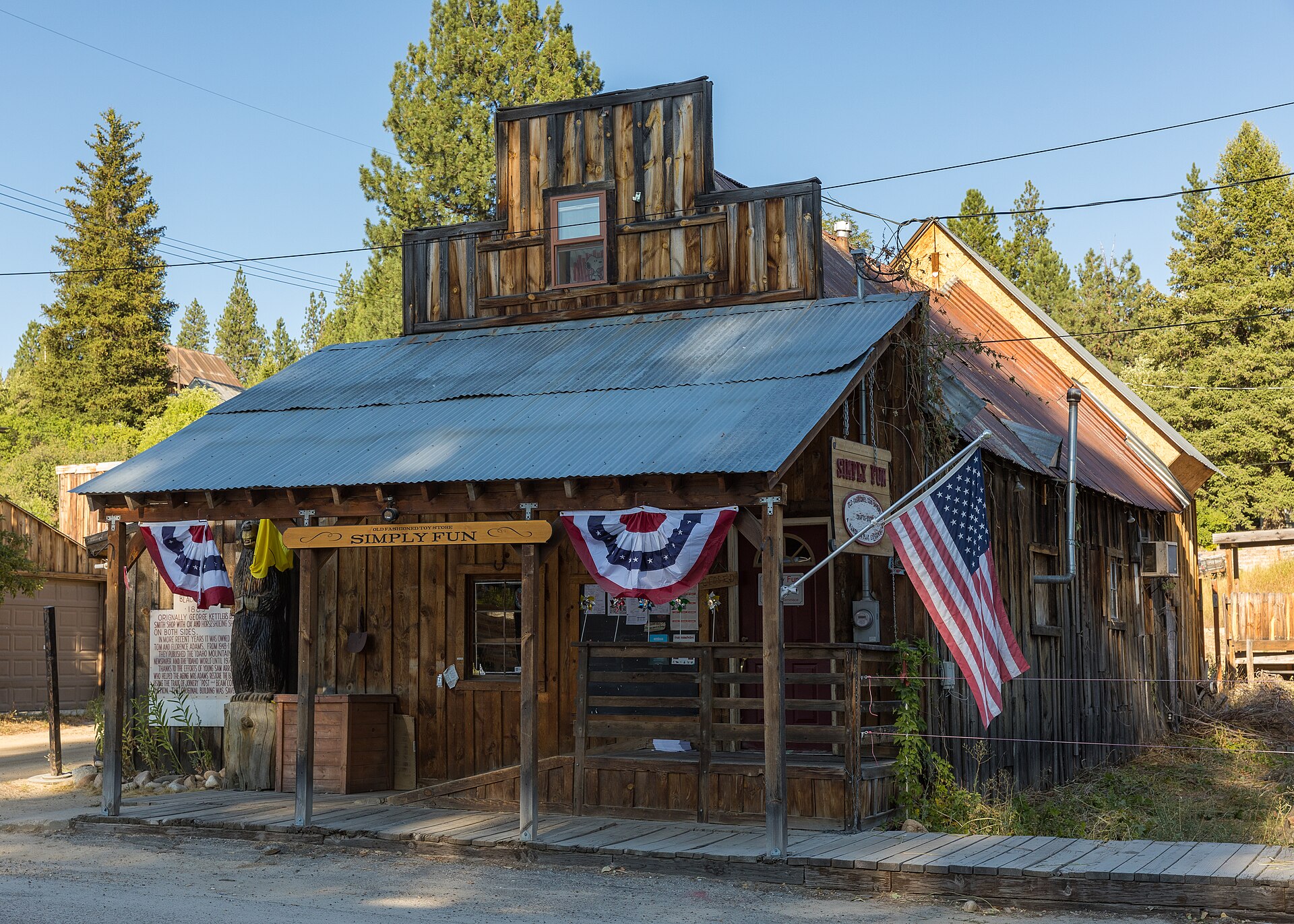
Idaho City is a small incorporated town in Boise County, about 38 miles northeast of Boise on Highway 21, that grew almost overnight in 1863 as the center of the Boise Basin gold rush. It is now the Boise County seat, with a few hundred year-round residents, a National Register of Historic Places historic district, and a handful of buildings that survived the fires and the decades after the gold ran out.
What was Idaho City before it was a tourist stop?
It was one of the largest settlements in the Pacific Northwest for a short, specific window. Gold was found in the Boise Basin in 1862 by a prospecting party that included George Grimes, and by the summer of 1863 thousands of miners, merchants, and camp followers had moved into what became Idaho City. Historical markers maintained by the Idaho State Historical Society state that the town’s population briefly rivaled or exceeded Portland and Seattle in the mid-1860s — a claim worth treating as a period estimate rather than a census figure, since no reliable formal count exists for a mining camp assembled that fast.
The town became the seat of Boise County almost immediately, a role it still holds. Idaho Territory itself was organized in 1863, partly because the Boise Basin’s gold had suddenly made this stretch of the Snake River plain and its mountains worth governing directly rather than administering from Washington or Oregon Territory.
How much gold actually came out of the Boise Basin?
Estimates place the total well into the hundreds of millions of dollars in gold, measured in the value of the era rather than adjusted figures. The Idaho State Historical Society and local historical accounts cite the Boise Basin — the cluster of drainages around Idaho City, Placerville, and Centerville — as one of the richest placer gold districts in the American West, worked first by individual miners with pans and rockers and later by hydraulic and dredge operations that reshaped entire creek beds.
That scale of production is why Idaho City filled in so fast, and why it emptied out almost as quickly once the easiest gold was gone. Placer mining is fast and shallow by nature: it strips what is near the surface and moves on. Within a decade, much of the basin’s population had already left for other strikes.
What actually survives from the gold rush era?
A working core of brick and wood-frame buildings from the 1860s and 1870s, a cemetery, and a county government that never moved out. Idaho City’s downtown is listed as a historic district on the National Register of Historic Places, which covers the town’s surviving commercial buildings, several churches, and its street layout rather than any single structure.
- The Boise County Courthouse — built in the 1860s and still the seat of Boise County government, making it one of the oldest continuously used courthouses in the state.
- Idaho City’s Pioneer Cemetery, often referred to locally as Boot Hill — burial ground dating to the gold rush years, with markers reflecting the era’s mining accidents, fires, and disputes.
- Idaho City Masonic Lodge — recognized by Masonic and state historical sources as the oldest continuously operating Masonic lodge in Idaho, chartered during the gold rush.
- St. Joseph’s Catholic Church — a surviving 19th-century church building associated with the town’s early Catholic congregation.
- The Boise Basin Museum — housed in a historic building in town and operated as a local history museum documenting the basin’s mining era, its buildings, and its population.
These buildings are not staged reconstructions. They are the actual structures — repaired, re-roofed, sometimes moved a few feet — that a mining-boom town built for itself when it briefly had the money and population to do so.

Why did so much of the original town burn down?
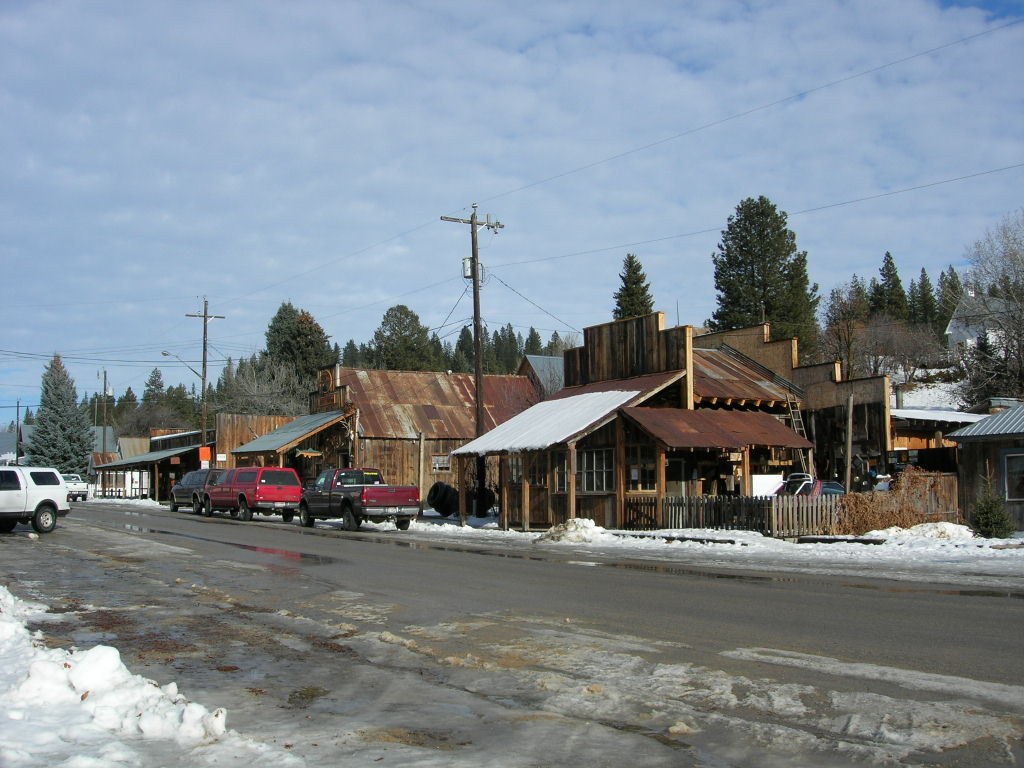
Idaho City burned repeatedly in its first decade, a pattern the Idaho State Historical Society and local histories both document — major fires in 1865, 1867, and 1871 destroyed large sections of the wooden boomtown. Dense wood-frame construction, wood stoves, and a town built fast with little planning made fire the dominant threat to any 1860s mining camp, and Idaho City was no exception.
What is standing today is mostly what was rebuilt after those fires, sometimes in brick specifically to resist the next one — which is part of why the surviving courthouse and a handful of commercial buildings are read by historians as representative of the town’s later, more settled 1870s character rather than its rawest 1863 boom.
What is Idaho City now, as a functioning place?
It is a small, permanently inhabited town and county seat, not a preserved ghost town. Boise County’s government still operates out of the historic courthouse, and the town supports a small resident population, a handful of local businesses, and seasonal visitor traffic drawn by its history and by its position inside the Boise National Forest.
The U.S. Forest Service manages the national forest land surrounding Idaho City, and the town functions as a supply point and gateway for recreation in the Boise Basin — forest roads, dispersed camping, and access to the South Fork Payette drainage all radiate out from around it. It is a working county seat with a gold rush history attached, rather than a museum piece with a town built around it for effect.
How do you actually get there from Boise?
By car, via Idaho State Highway 21, a route also known locally as the Ponderosa Pine Scenic Byway, which climbs out of the Boise foothills and into the Boise National Forest before reaching Idaho City. There is no public transit connection, so a private vehicle is effectively required, which readers weighing whether they need a car in Boise at all should factor in separately, as covered in the site’s guide to whether you need a car in Boise.
The drive runs through forested, winding mountain terrain rather than open highway, and conditions change with the season — snow and ice are a real factor from late fall through spring, which is worth reading against the site’s notes on winter driving conditions around Boise before planning a cold-season trip. For a sense of how this distance compares to other things reachable from downtown Boise, see the site’s breakdown of how far apart everything in Boise actually is.
Does a trip to Idaho City fit into a normal Boise visit?
It works best as a half-day or full-day addition rather than a first-day stop, since it requires a drive out of the city and is not connected to any of downtown Boise’s core sights. Visitors organizing a longer stay around the site’s own itinerary structure may find it fits naturally into planning covered in what a third day in Boise makes room for, once the city’s core museums, parks, and neighborhoods are already accounted for.
Readers building a broader day-trip plan around Boise’s landmarks and historic sites more generally can start from the site’s Landmarks & Sights archive or its wider Itineraries & Day Plans archive, both of which cover how Boise’s own historic core — separate from Idaho City — is organized for a self-directed visit. The main hub for understanding Boise’s museums, neighborhoods, and day-trip options as a whole is the site’s Boise guide hub.
What should a reader confirm before going?
Museum hours, courthouse access, and road conditions on Highway 21 all change by season and are set by the relevant operators, not by this site. The Boise National Forest, which manages the land around Idaho City, publishes current road and forest conditions on its own site, and the Idaho State Historical Society publishes historical context and marker text that is worth checking directly rather than relying on secondhand summaries.
- Boise National Forest, U.S. Forest Service — for current forest road, fire, and access conditions: fs.usda.gov/boise
- Idaho State Historical Society — for verified historical background on the Boise Basin gold rush and Idaho City’s listed sites: history.idaho.gov
Neither body functions as a booking service or a tour operator; both are the primary record-keepers for what actually happened in the Boise Basin and what remains protected today.
Related reading
what the city is like to actually live in, Boise, Practically, What Is Redfish Lake, Idaho? A Straight Answer
Access Boise is an independent guide written from published, checkable sources. We have not visited the places described here and we do not publish personal recommendations or invented ‘local favourites’ — where something is singled out as notable, we say who says so. Opening times, fares, closures and prices change at short notice, so treat everything here as a starting point and confirm with the museum, operator or venue directly before building a day around it. We give no advice on visas, insurance, health or safety; use your own government’s official guidance for those.
Featured image: Photo by Frank Schulenburg, source, CC BY-SA 4.0
